Idiotfool wrote: ↑Sat Feb 20, 2021 4:40 pm
If though can’t trickle charge with solar because you can’t trickle charge, how would you ever charge with solar? Can you charge via outboard alternator? Backup generator?
I’ve seen a number of Youtubers with electric conversion boats running solar, so I’m puzzled why you couldn’t keep your batteries topped up with solar and a proper BMS.
That's a really good question and I think I failed to explain it fully. I need to another CON and be more thorough.
First, let me define
Trickle Charging as continuing to charge once the battery is at 100% SOC versus just charging at a low current rate. Yes... a single, small solar panel only delivers at a rate that even a small trickle charger can out do.
A
lead-acid battery in storage... say its disconnected from any loads, brought into the garage and hooked up to a small trickle charger. The lead-acid battery is perfectly ok to be ignored the whole winter. In fact it almost has to have that charger on it. Lead-acid batteries can self discharge even if there is no load and if they get down to 0% SOC, it is severely damaged.
Lithium batteries in general and specifically LiFePO4 batteries prefer not to be at 100% SOC for long periods of time. It will deteriorate them. So... for our example of disconnecting loads and hooking up a trickle charger while in the garage, we'd be keeping it at 100% SOC all the time. The better thing to do is to drain it some and just let it set without a charger of any sort. For long term storage (months) the suggested number is to drain it down to about 13.15 volts. This is around 40% SOC. Although being new to this and worried about my investment, I might check it every once in a while. LiFePO4 batteries have almost zero self-discharge, so they are unlikely to drain further over the months.
NOW, for a more realistic case, I'm putting in one of the AirHead Composting Toilets. It uses a small fan to exhaust the fumes. Also, I'll likely have some electronics running. Say all told, I'm running less than five watts. Obviously, even this can drain a battery over several months. I'm currently in a thread with those experts on the other forum that will handle this beautifully. Basically the BMS can be configured so that it cycles from say... 40% to 70% SOC. It also reduces the number of charge cycles, so the battery longevity actually goes up during the winter. Just because of this reduced cycling strategy an estimate 50% increase in battery life... say from 10 years to 15 years might be achieved.
Let me know if this answers your question fully. I've been known to ramble the wrong direction.


 we run the stereo hard, even though it is an efficient marine system, the fridge, and various other gadgets. I sincerely hate lead acid with a passion. I truly believe the lithium will be cheaper in the long run considering energy costs and time savings to charge the battery. I'll post some updates here once I get it in the boat and begin to use it.


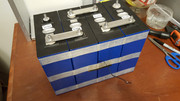
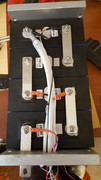
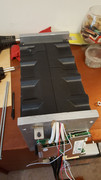
 battery compartment. Points of interest: The main cable coming from the negative post of the series connected cells. Five smaller wires are for cell monitoring and keeping the cells balanced. Also note the two silver end plates. These are simply 3/4" plywood. These are to compress the cells as was discussed in this post: