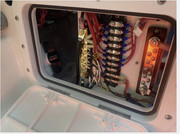
I was asked if I could make a new topic thread on some of the modifications/ improvements we have made on Over Easy.
This is for our “DUAL BATTERY SELECT CHARGE & USE CONTROL SWITCH SYSTEM” Modification.
BACKGROUND:
Batteries are all slightly (and sometimes more than) different from each other depending upon prior usage, discharge cycles, recharge process, age, chemistry and type category. Some get used a lot just for a quick start while others are long laborious drawn out affairs that each affect a battery differently over time. Some are drawn down just a little, others a lot. Some get recharged with regular usage and others sit idle for weeks on end. Some are brand sparky new and others are examples of geriatric wonder.
Some batteries are START batteries, some are STORAGE DEEP CYCLE batteries, some are DUAL PURPOSE START/STORAGE batteries.
Some are basic lead acid types, some nickel-cadmium and then there others are ‘exotic’ Lithium-carbon-hyroxigenated-*gawdonlyknowswhatkindastuff chemistries.
Some a liquid, some are gel, some have meshes, some have plates and some I really don’t want to know constructions (‘cause I might not sleep again
 ).
).All these examples are to explain that no two batteries are quite the same and they generally like to be charged “independently” of each other. The easiest example pair most are familiar with are START and DEEP CYCLE batteries. Most modern commercially available battery chargers worth owning have a selector switch for each of these types. (NOTE: As was explained to us the DUAL PURPOSE START/STORAGE battery is actually more like a DEEP CYCLE than a START battery and should be charged as a DEEP CYCLE.
This system is identical to a system we have utilized for over a decade and a half on a 30 foot RV trailer to replace the factory charge/use controller that repeatedly failed/replaced/failed and repeatedly ruined multiple expensive RV Deep Cycle batteries prematurely. The factory system insisted on and was only capable of charging both batteries at the same time while at the same time was only capable of drawing from both batteries at the same time whether charging or not. What this did was set up the batteries to compete with each other for charge which caused more amperage to be delivered to the more fully charged battery than it needed leading to over heating of that battery, electrolyte boil off and internal damage. In a related manner when drawing from both batteries the weaker battery ‘robbed’ charge from the stronger battery which drew down the system faster than they would have separately.
The fix to this was to use all those years as a design/development/analysis applied engineer and chuck the factory battery system (and the very nice rep
 ), actually use what people paid me for
  and make a system that put us back in control of the process while not having to physically fuss with the batteries clipping/unclipping charger leads etc...
Once we implemented this we no longer had any charger failures or premature damage or wear out of our RV Deep Cycle batteries.
After the change over our battery life improved to over 6+ years (often 8 yrs).
This system allows for the charging of different battery types and constructions by being able to change the shore power charger setting to match the battery type.
Our experience was and is based upon lead acid type chemistry batteries.
CRITICAL NOTE:
I personally WOULD NEVER EVER ATTEMPT to use either the CHARGE or USE selector switch in the Both Or ALL positions when working with batteries of conventional lead acid AND exotic chemistries. Some exotic batteries have differing charge/output voltages that can cause serious problems. Some exotic batteries can/have experienced substantial exothermic and/or catastrophic failure due to internal current/voltage issues. Past experience in equipment/system design has taught me to NEVER MIX conventional lead acid batteries with any other chemistry (ESPECIALLY EXOTIC LITHIUM BASED). The potential risk of injury/damage to personnel, property or equipment just isn’t worth it after having to deal with the aftermaths of other individuals attempts.
WHAT THIS SWITCHING SYSTEM ACCOMPLISHES:
A) This system described here is a ‘clean’ means to manually address isolating an individual battery of a dual battery system for charging from a shore power charger while the other battery is available to run the ‘house’ or boat 12 volt DC systems.
B) This system also allows you to swap which battery is charging and which one is being used to run the ‘house’ or boat 12 VDC systems.
C) It also allows one to charge and or use both batteries concurrently if necessary (though my personal choice is to never be USING the battery BEING CHARGED from the shore powered charger.)
D) Allows one or the other or both batteries to be charged from the engine when it is in operation (if it has that capability through the engine start leads).
WHAT WE CHOSE TO DO:
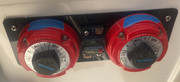
Using a pair of standard off the shelf Perko 8501DP Marine use Dual Battery Switches and a quality Automatic current limiting charger (which means that once the battery is charged the charger converts automatically to a trickle charger to maintain the battery over protracted periods of time without damage) along with a 1/4 sheet of Lexan polycarbonate sheet we fabricated the following:
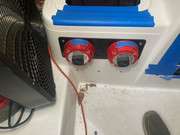
Please pardon the in process photo and blue tape labels as we haven’t yet unpacked the LABEL MAKER (such a wonderful device
 ).
).The switch on the left (Aft) controls which battery(s) is/are getting charged from the shore powered charger.
The switch on the right (Forwardj controls which battery(s) is/are getting used by the ‘House’ or boat and engine systems.
A hand sketch of the wiring schematic is below:
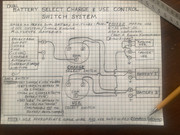
We used Marine Grade Use #6 AWG ELECTRICAL CABLES THROUGH OUT this design.
All lines are makes at both ends.
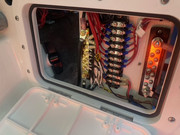
There is a HARDWIRED COMMON GROUND leads to appropriately sized Marine Grade Buss Bars for both Positive and Negative functions.
BASIC SWITCH OPERATION:
Begin with everything turned off including the shore power battery charger.
A) Set the CHARGE & USE SWITCHES to the “OFF” position
B) Set the CHARGE switch to the battery to be charged
C) Turn on the shore powered battery charger which has been set to the proper battery type and chemistry.
—-> Allow the battery to come fully up to charge as indicated on the gauges of the shore powered charger.
As needed:
——-> Turn off the shore powered charger
———-> Set the shore powered charger for the proper type and chemistry of the next battery
—————-> Change the CHARGE Selector switch to the next battery and turn on shore powered charger
D) Set the USE switch to the battery NOT BEING CHARGED to enable electrical power to be distributed to the vessel.
As needed:
——> Change the USE switch select to OFF to isolate both batteries from the vessel systems.
——> When the current in use battery has been depleted change over to the alternate battery AFTER making sure that that battery is not being charged from the shore power charger.
E) IF ONE DESIRES one can still choose to charge both batteries at the same time simply by changing the CHARGE selector switch to ALL
F) IF ONE DESIRES one can still choose to draw off both batteries at the same time simply by changing the USE selector switch to ALL
G) FOR ENGINE STARTING battery selection is accomplished from the USE selector switch
Options are Battery 1/Battery 2/Both(ALL)
H) ENGINE CHARGING OF THE BATTERIES is accomplished by setting the CHARGE selector switch to OFF and setting the USE selector switch to either Battery 1/ Battery 2/Both(ALL)
BASELINE UNDERSTANDING:
As with anything that anyone does it is the full responsibility of the person doing the work and using the system to do it properly with the appropriate parts and connections taking care to ensure and check there are no miswires, mistakes or errors. That each wire is appropriately sized, terminated and insulated. All qualified technicians utilize the proper tools (proper crimpers, terminals, heat-shrink, wrenches, etc...) and circuit integrity checks BEFORE applying ANY power to ANY ELECTRICAL CIRCUIT.
SPECIAL CAUTIONARY NOTE:
ELECTRICIANS TAPE IS NEVER TO BE USED AS ELECTRICAL INSULATION WHEN THERE IS ANY RISK OF HARM TO PERSONNEL, PROPERTY OR EQUIPMENT. EVER.
This is what we chose to do, have used in the past and are comfortable with.

Hope this helps.
Best Regards from Over Easy!




 Congratulations. I was able to get my first round last week. I'm sure ready for some trend toward the old normal.

 I know in an emergency, I'd just by-pass the BMS, but that is because in a DIY solution, I have access to those inner connections. Even if a solution existed, I think I'd still keep the segregated... lead-acid to start the engine and charged by the engine. And separately a house-only battery charged by solar/wind/shore power or with the engine's alternator with safeguards for the motor.