Electrical Ideas

A forum for discussing topics relating to MacGregor Powersailor Sailboats
Post Reply
User avatar
pitchpolehobie
Captain
Posts: 595
Joined: Wed Dec 18, 2019 8:46 pm
Sailboat: MacGregor 26X
Location: USA, OH

Electrical Ideas

Post by pitchpolehobie »

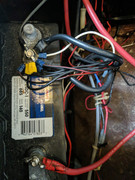
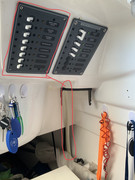
Hi guys I am taking input on how to update my electrical system on 02 26X with perkeo selector switch, 2 deep cycle batteries and a 25HP that charges house batteries that can be started w pull cord if needed. Current electrical demands include
  • original cabin lights- now LED
  • GPS and Depth Finder
  • Mast and Running Lights
  • DC adapter port on galley and one on binnacle - both work

It seems to be a mess from PO but works OK and I haven't had any issues with my typical use off grid for 7 straight days of sailing and light motoring to dock or anchor.
I'd like to get a bus bar I think (taking ideas for which I would need) and wondering if I need another panel.
Image

The 2 DC adapters are really useful for phones, charging a laptop via DC, and charging some fans we use to move around the cabin. I wouldn't mind a total of 5 DC ports for charging fans, phones on a daily trip basis and rarely a low power intel atom laptop.
  • extra DC by the dinette
  • extra DC by the V berth
  • extra DC by the port settle behind the sink
I don't think I really need AC with my current use case, my 25HP outboard charges up the battery bank well. I have a 50 watt panel waiting to install but would like to make sure I need it


Questions I have:
1. Which Bus bar should I use to make things neater
2. Do I need another DC Fuse Panel
3. Which DC adapter plugs Do I Need?
4. What wiring should I use so I won't need to redo it.
5. How hard to wire in a 50 watt solar and charge controller.

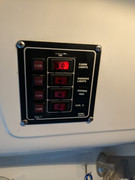
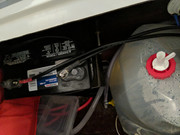
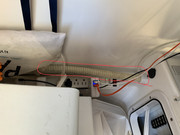
Extra pics of standard fuse panel and my 2nd battery under port setee.
Image
Image
2002 MacGregor 26X: Remedium
Tohatsu 25HP
Cruising Area: Inland Ohio, Lake Erie
User avatar
Starscream
Admiral
Posts: 1565
Joined: Tue Nov 03, 2009 10:08 am
Sailboat: MacGregor 26X
Location: Montreal, Quebec. 2002 26X - Suzi DF90A

Re: Electrical Ideas

Post by Starscream »

Here are my answers to those questions, although your usage/needs may be totally different:

Questions I have:
1. Which Bus bar should I use to make things neater
For the main panel, I stayed with the Macgregor Bolt wrapped in electrical tape. If it ain't broke... It doesn't meet any sort of yachting standards, but is very compact. For the secondary panel (see 2 below), and for the items wired directly to the battery like bilge pumps I used simple DC bus bars, mounted on a slice of HDPE that is bolted or epoxied in place, like this one:
https://www.amazon.ca/Distribution-BusB ... s9dHJ1ZQ==

2. Do I need another DC Fuse Panel
Eventually, everyone needs another DC fuse panel (IMO). I started by replacing the original with a 6-fuse panel, then I added the original 4-fuse panel back in on the starboard side. Over time, the boat has become more and more comfortable with electrical gadgets, and waaay outgrown the original 4-gang panel.

3. Which DC adapter plugs Do I Need?
You can get 12V DC adapters from Amazon that work just fine, or any marine store. I have installed dedicated USB charging ports all over the boat, but be aware that most of them draw current when not in use, through little indicator lights. The best option I found is one with an integrated on/off switch like this one:
https://www.amazon.ca/gp/product/B07PZZ ... UTF8&psc=1

4. What wiring should I use so I won't need to redo it.
I use marine tinned wire in all cases, gauge appropriate to current. This stuff is strong, durable, and very well sheathed.
https://www.amazon.ca/Ancor-Marine-Grad ... 71&sr=8-12

5. How hard to wire in a 50 watt solar and charge controller.
Piece of cake. With a single battery it becomes an independent system easily wired to the battery terminals. For a dual battery system it's a bit more complicated on how to make it charge both batteries. I chose to go with a Blue Seas ACR that automatically combines the batteries for charging when a charging voltage is sensed, and un-combines them when it senses that a battery is being discharged through load. I have two 50W solar panels mounted on the bimini top, Y-ed together with MC4 connectors and then connected to the wire heading to the charge controller with SAE automotive quick-connects. The wire runs down the backstay through the motor wiring boot into the bilge, and around to the solar controller and battery monitor that I have mounted under the galley, on the chine of the hull. Needs a little work to check, but real-estate to mount things is at a premium, and the system doesn't need to be checked often.
User avatar
Russ
Admiral
Posts: 8341
Joined: Thu Oct 11, 2007 12:01 pm
Sailboat: MacGregor 26M
Location: Bozeman, Montana "Luna Azul" 2008 M 70hp Suzi

Re: Electrical Ideas

Post by Russ »

I don't know how you are fusing the house loads, but I believe code states fuses must be within inches of the terminal.

I found these to work really well for that purpose.

--Russ
User avatar
Be Free
Admiral
Posts: 1919
Joined: Fri Nov 23, 2012 6:08 pm
Sailboat: MacGregor 26X
Location: Steinhatchee, FL

Re: Electrical Ideas

Post by Be Free »

+1 on all previous comments.

ABYC requires the fuse to be within 7" of the battery. Unless you are worried about a surveyor dinging you on a future sale read that "as close as practical but try for 7". You will need one on each battery.

Bus bars make everything easier to work on. Don't forget to label as you go and diagram what you do. No matter how much you tell yourself you are going to remember how you did it, you won't.

Do not use wing nuts on the battery. Use hex nuts and a lock washer. Nylon lock nuts will do in a pinch but I've seen the nylon soften and deform if the current is too high. I prefer not to use them on a battery.

You have way too many wires connected to the battery terminal. Try to keep it down to 2 or three with the largest connectors at the bottom. Most of the current is coming through the flat part of the connection, not the part around the post. You want to maximize this contact area. This will not be a problem once you have your bus bars.

As much as I like the built-in, finished look of a USB power point I'd recommend putting in all "cigarette lighter" type DC power points and adding in USB converters when you need them. The "lighter" connectors seldom wear out and they give you the option of changing the USB part as standards evolve. Make sure anything in the cockpit is water tight when not in use. Each should be individually fused. An inline fuse at the bus bar connection is fine.
Bill
2001 26X Simple Interest
Honda BF40D
"If I were in a hurry I would not have bought a sailboat." Me
wakataka
Chief Steward
Posts: 53
Joined: Mon Jul 06, 2015 10:06 pm
Sailboat: MacGregor 26X
Location: Redding California

Re: Electrical Ideas

Post by wakataka »

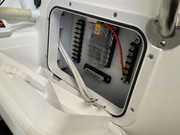
I added this as a second panel.
https://www.amazon.com/gp/product/B00M3 ... UTF8&psc=1
It's worked well for 4 years now. It doesn't really provide a true bus bar but the breakers are pre-wired in parallel so you only need to provide one power and one ground wire to the panel. I found the 12v outlet to be a handy feature for powering USB chargers. I installed it on the aft wall of the galley, which made for a short run of the larger gauge wire from the battery to the panel. Be sure you use wire of sufficient gauge to carry the load of everything connected to the panel. The back of the panel intrudes just a bit into the space under the galley counter top. I found a plastic storage bin that was just the right size to cover the back of the panel and protect the wiring.
adventuren1
Just Enlisted
Posts: 16
Joined: Sun Dec 05, 2021 9:19 pm
Sailboat: MacGregor 21
Location: Port Townsend, WA

Re: Electrical Ideas

Post by adventuren1 »

I completely rebuilt the electrical in my 1999 26X. I started with 2 AGM batteries and the replaced all the wires. Much of the lamp cord wire was in surprisingly good shape though. I used too big of a battery switch to start out, but it worked. Then a 12 position Blue Sea fuse panel to distribute the loads. One thing I learned recently to consider in designing your system is the difference and interaction of all the panel and switch choices. Some of the things to consider about all the fancy parts you can buy...
Fuse panels distribute power to loads with the ability to set the fuse to the load.
Fused switch panels give you the same feature, with a switch. It can be powered from the main source since it has it's own fuses.
Breaker switch panels are set at 15 amps. You cannot change that. So running a LED light on a breaker switch is overkill for example.
Plain switch panels have no fuse or breaker and need to be fed from a fuse panel. (Or inline fuses which I hate.)
Bus bars are good for connecting ground wires
Terminal blocks are good for connecting hot side of loads.
I am in no way saying I did it by "code". You are not required to meet code on a privately owned, DIY boat project. But you should try to meet it best you can. There are reasons for codes, and they usually stem from bad advice gotten on an internet forum ;) I attached a couple photos of my switch panel upgrade, which I would do differently now. This switch panel is a 15 amp breaker panel and not he best choice for all the loads on it.
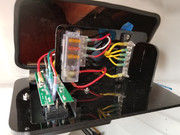
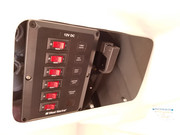
Image

Image
User avatar
pitchpolehobie
Captain
Posts: 595
Joined: Wed Dec 18, 2019 8:46 pm
Sailboat: MacGregor 26X
Location: USA, OH

Re: Electrical Ideas

Post by pitchpolehobie »

adventuren1 wrote: Fri Dec 10, 2021 10:35 pm I completely rebuilt the electrical in my 1999 26X. I started with 2 AGM batteries and the replaced all the wires. Much of the lamp cord wire was in surprisingly good shape though. I used too big of a battery switch to start out, but it worked. Then a 12 position Blue Sea fuse panel to distribute the loads. One thing I learned recently to consider in designing your system is the difference and interaction of all the panel and switch choices. Some of the things to consider about all the fancy parts you can buy...
Fuse panels distribute power to loads with the ability to set the fuse to the load.
Fused switch panels give you the same feature, with a switch. It can be powered from the main source since it has it's own fuses.
Breaker switch panels are set at 15 amps. You cannot change that. So running a LED light on a breaker switch is overkill for example.
Plain switch panels have no fuse or breaker and need to be fed from a fuse panel. (Or inline fuses which I hate.)
Bus bars are good for connecting ground wires
Terminal blocks are good for connecting hot side of loads.
I am in no way saying I did it by "code". You are not required to meet code on a privately owned, DIY boat project. But you should try to meet it best you can. There are reasons for codes, and they usually stem from bad advice gotten on an internet forum ;) I attached a couple photos of my switch panel upgrade, which I would do differently now. This switch panel is a 15 amp breaker panel and not he best choice for all the loads on it.
Image

Image
Great input, yes I got a book to revie prior to when I do mine and also appreciate everyones help in this thread so far. Will post links likely in 2-3 mos when I make my purchase and do the project for everyones review.
2002 MacGregor 26X: Remedium
Tohatsu 25HP
Cruising Area: Inland Ohio, Lake Erie
User avatar
Be Free
Admiral
Posts: 1919
Joined: Fri Nov 23, 2012 6:08 pm
Sailboat: MacGregor 26X
Location: Steinhatchee, FL

Re: Electrical Ideas

Post by Be Free »

When you are designing your wiring remember that the fuse is sized to protect the wire, not the the device(s) on it. If there is only one device on the circuit you could under-size the fuse for the expected load of that one device but I would not recommend it.
Bill
2001 26X Simple Interest
Honda BF40D
"If I were in a hurry I would not have bought a sailboat." Me
User avatar
Starscream
Admiral
Posts: 1565
Joined: Tue Nov 03, 2009 10:08 am
Sailboat: MacGregor 26X
Location: Montreal, Quebec. 2002 26X - Suzi DF90A

Re: Electrical Ideas

Post by Starscream »

Be Free wrote: Sat Dec 11, 2021 6:42 am When you are designing your wiring remember that the fuse is sized to protect the wire, not the the device(s) on it. If there is only one device on the circuit you could under-size the fuse for the expected load of that one device but I would not recommend it.
I've always designed my circuits according to the MCA and MOCP rules in the NEC (as I understand them.) These rules are based on the devices FLA (full load amps) in the circuit being designed.

The MCA (minimum circuit ampacity) rule says that everything in the circuit, including the wires, must be sized/rated to handle 1.25 times the sum total full load amps of the devices on the circuit. There is a temperature adjustment for sizing the wires, but it doesn't really affect my Canadian boat.

The MOCP (maximum overcurrent protection) rule states that the fuse or breaker cannot be rated higher than 2.25 times the largest single device FLA on the circuit, plus all the other device loads on the circuit. The breaker must also be rated higher than the MCA. There are usually a few possible fuse sizes that work in between the MCA and MOCP, and it's usually logical to pick the highest size allowed to avoid nuisance trips.

There is a condition where the MCA can be higher than the MOCP of a circuit (usually when there are a bunch of small loads on one circuit), and in that case the MOCP is bumped up to equal the MCA and the fuse or breaker is the next available, higher size than the MCA. For example, if the MCA is 18 and and the MOCP is 17, the MOCP is made equal to 18 and a 20 amp breaker is required.

My understanding of the rules is that the fuse or breaker IS designed according to the devices on the circuit, and if all the rules are followed it will protect the wires in conjunction with appropriately sizing the wires for the MCA. I haven't found anything in the rules that says I couldn't wire a 1-amp load with 1 gauge wire (huge overkill, since that wire could handle a massive amount of amps) and protect it with a 2-amp fuse.
User avatar
Be Free
Admiral
Posts: 1919
Joined: Fri Nov 23, 2012 6:08 pm
Sailboat: MacGregor 26X
Location: Steinhatchee, FL

Re: Electrical Ideas

Post by Be Free »

Starscream wrote: Sat Dec 11, 2021 8:02 am
Be Free wrote: Sat Dec 11, 2021 6:42 am When you are designing your wiring remember that the fuse is sized to protect the wire, not the the device(s) on it. If there is only one device on the circuit you could under-size the fuse for the expected load of that one device but I would not recommend it.
I've always designed my circuits according to the MCA and MOCP rules in the NEC (as I understand them.) These rules are based on the devices FLA (full load amps) in the circuit being designed.

The MCA (minimum circuit ampacity) rule says that everything in the circuit, including the wires, must be sized/rated to handle 1.25 times the sum total full load amps of the devices on the circuit. There is a temperature adjustment for sizing the wires, but it doesn't really affect my Canadian boat.

The MOCP (maximum overcurrent protection) rule states that the fuse or breaker cannot be rated higher than 2.25 times the largest single device FLA on the circuit, plus all the other device loads on the circuit. The breaker must also be rated higher than the MCA. There are usually a few possible fuse sizes that work in between the MCA and MOCP, and it's usually logical to pick the highest size allowed to avoid nuisance trips.

There is a condition where the MCA can be higher than the MOCP of a circuit (usually when there are a bunch of small loads on one circuit), and in that case the MOCP is bumped up to equal the MCA and the fuse or breaker is the next available, higher size than the MCA. For example, if the MCA is 18 and and the MOCP is 17, the MOCP is made equal to 18 and a 20 amp breaker is required.

My understanding of the rules is that the fuse or breaker IS designed according to the devices on the circuit, and if all the rules are followed it will protect the wires in conjunction with appropriately sizing the wires for the MCA. I haven't found anything in the rules that says I couldn't wire a 1-amp load with 1 gauge wire (huge overkill, since that wire could handle a massive amount of amps) and protect it with a 2-amp fuse.
As I understand the above:
Following those rules the wire will be sized 25% higher than the expected loads and the breaker will always be less than than the capacity of the wire. Device loads determine minimum wire size and wire size determines maximum current protection size. The rules above may call for a smaller breaker than the wire size would indicate, but never larger.

No argument that you can use a wire much larger than the expected load would require or put in a breaker/fuse significantly less than the capacity of the wire. There are very good reasons for the former (up to a point e.g. minimizing voltage drop, planning for future growth...). I can't think of a good reason for the latter but I'm open to instruction.
Bill
2001 26X Simple Interest
Honda BF40D
"If I were in a hurry I would not have bought a sailboat." Me
User avatar
Starscream
Admiral
Posts: 1565
Joined: Tue Nov 03, 2009 10:08 am
Sailboat: MacGregor 26X
Location: Montreal, Quebec. 2002 26X - Suzi DF90A

Re: Electrical Ideas

Post by Starscream »

Be Free wrote: Sat Dec 11, 2021 12:03 pm
As I understand the above:
Following those rules the wire will be sized 25% higher than the expected loads and the breaker will always be less than than the capacity of the wire. Device loads determine minimum wire size and wire size determines maximum current protection size. The rules above may call for a smaller breaker than the wire size would indicate, but never larger.

No argument that you can use a wire much larger than the expected load would require or put in a breaker/fuse significantly less than the capacity of the wire. There are very good reasons for the former (up to a point e.g. minimizing voltage drop, planning for future growth...). I can't think of a good reason for the latter but I'm open to instruction.
I'm fairly sure the wire size does not determine the fuse size, but I'm also open to instruction. The fuse size is determined by the MOCP, which is based on the loads. The formula for MOCP is (2.25*largest FLA + sum of all other FLA). The FLA's in the MOCP formula refer to the DEVICES in the circuit. The wire size is determined by the MCA, which is calculated by adding all the FLA's of the DEVICES in the circuit and multiplying by 1.25. Nothing in the circuit is allowed to have a smaller rating than the MCA.

MCA is MINIMUM circuit ampacity. There is no such thing as MAXIMUM circuit ampacity, so you can put any larger size wire you want, as long as it is ratedfor current higher than the MCA.

MOCP is MAXIMUM overcurrent protection. The fuse can't be any bigger than this, so you usually round down to the nearest standard fuse size. It also can't be any smaller than the MCA (since everything in the circuit has to respect MCA). ((except in that weird situation where there are lots of little loads and the MOCP formula comes out smaller than the MCA))


For example: Let's say we have a circuit with two 1 amp loads and one 3 amp load. The MCA = 1.25 * (1+1+3) = 6.25. That means that the wire and the fuses would have to be rated to carry MORE than 6.25 amps. For the wire, there is no upper limit. Then, we need to calculate the fuse size. The MOCP is (2.25*3 + 1 + 1) = 8.75, so this would be the maximum fuse rating, and we would round down to the nearest standard fuse size, which is 7.5 amps. A quick check of the MCA vs the fuse size shows that this fuse is greater than the MCA and lower than the MOCP, so it is acceptable. This leaves me the option to put any wire size I want, greater than a 6.25 amp rating. I could put 00 wire with 145 Amp rating, no problem. It's the LOADS that will determine the current in the wire, the fuse size, and the MINIMUM wire size.

Anyway, that's how I've always done it...I hope it's right because my whole boat is done like that :D
User avatar
Starscream
Admiral
Posts: 1565
Joined: Tue Nov 03, 2009 10:08 am
Sailboat: MacGregor 26X
Location: Montreal, Quebec. 2002 26X - Suzi DF90A

Re: Electrical Ideas

Post by Starscream »

I guess I should add to my comment above.

The description above is to design the main power line in a circuit, like from the battery to a fuse panel, or from a single fuse to a single device, or from a single fuse to a bus bar. If there are multiple devices on the same circuit, then the fuse or breaker for that circuit is designed as above, but a bus-bar should be used to split the circuit into individually fused wires for each device. Each split from the bus bar is treated as an individual circuit, and each wire should be individually sized for the load that it is feeding, with its own individual fuse, according to the rules above.

Taking the example of one 3 amp load and two 1 amp loads on a single breaker, the breaker for that circuit and the wire leading to the bus bar is sized as per the description above. At the bus bar, the 3-amp device wire would have an MCA of 3.75 and a MOCP of 6.75. The 3 amp load could therefore have a 5 or a 6 amp fuse at the bus-bar, and the wire would have to be rated to carry at least 3.75amps. The two 1-amp loads would have an MCA of 1.25 each, and an MOCP of 2.25 amps each, so either a 1.5 or 2 amp fuse and wire rated to carry 1.25 amps.

There is a strong reason to use wire that is rated (significantly) higher than the MCA, which is to keep the voltage drop at a minimum. The larger the wire, the more voltage gets to the device that needs it, and this can have a huge impact over long distances. When I installed our E-tec-90, the dealer used the original wires from the Honda BF50A which were barely adequate to start the 50, and the voltage drop caused starting problems with the 90 until we changed out the wire.
Sheppie62
First Officer
Posts: 351
Joined: Thu Sep 28, 2017 1:04 pm
Sailboat: MacGregor 26X
Location: Mission Bay San Diego

Overeasy style sub panel

Post by Sheppie62 »

I copied Overeasy’s galley DC sub panel and ran flex PVC for conduit up to the breaker/ switch panel. Now battery power starts at busbar in sub panel, goes up conduit (10ga fused wire & ground) to breaker/ switch panel and 8 wires come back (hot when switched on) to another busbar in sub panel. I put a fuse panel inside sub panel as well. I don’t really don’t know what I’m doing so please comment if you desire. I don’t know why pvc turned kinda yellow, was nice and white when I bought it. I’ll try cleaning it later.

Image

Image

Image
OverEasy
Admiral
Posts: 2935
Joined: Mon Sep 28, 2020 11:16 am
Sailboat: MacGregor 26X
Location: NH & SC

Re: Electrical Ideas

Post by OverEasy »

Hi Sheppie62!

Nice job on your electrical up grade!👍👍
It looks great!

The PVC sanitary tubing ….. I’ve seen this happen before with some brands. I’ve also seen the surface develop a “sticky” feel. It’s one of the characteristics of that type of flex tubing.(It’s why I used the UV rated Titeflex (grey) electrical flex conduits.

Not sure if it works but I’ve been told a lintless rag saturated with Windex should remove the surface “sticky” and possibly the yellowing. Follow up with clean lintless rag and Pledge Furniture Polish to “seal” the surface. Again, this is what I’ve been told, not something I have done myself. Maybe try on a scrap piece with a similar condition first.

Best Regards,
Over Easy
😎😎🐩🐈
Post Reply