

Hello, I wanted to know the best way to raise my boat up so I can get the trailer out. I can weld up my own stands, so if anyone has time to point me in the right direction. Maybe a You Tube link? The boat and trailer I’m looking at buying needs some TLC
Thank you
Starlight
MacGregor 25 trailer removal

-
OverEasy
- Admiral
- Posts: 2873
- Joined: Mon Sep 28, 2020 11:16 am
- Sailboat: MacGregor 26X
- Location: NH & SC
Re: MacGregor 25 trailer removal
Hi StarLight
That dual gantry thing looks interesting but it doesn’t look inexpensive either…especially for a one time use.
If I were wanting to work on the trailer I first consider if it were possible to transit the boat and trailer to a local boat ramp to launch the boat and arrange to have the boat tied up at a marina or dock or properly moored. That would be my first choice for safety and convenience. I’d even look at contacting folks with waterfront property to see if an arrangement could be worked out.
My second choice would be to see if a local boat yard to see if they can help as they may already have the equipment/facility to help you with this.
This is what we did to get our boat lifted, cleaned, epoxy primed and our initial ablative bottom paint applied.
This was a good cost/time effective solution for us at that time.
What I’ve subsequently done to do the bottom painting on our Mac26X is the “teeter-toter “ approach to get the boat lifted off the trailer and onto robust wooden support frames in my driveway. Now mind you I was only wanting minimal clearance to do boat bottom maintenance and not fully remove the trailer from under the boat but the process could be similar.
Here’s what I did…
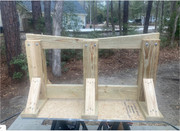
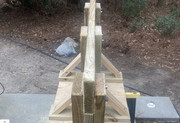
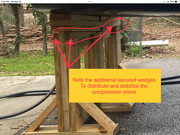
I built a sturdy stable robust cradle from 2x6 PT lumber more than capable of supporting 3000+ lbs for the rear of the boat that lined up with the hull at the stern overhang with the tongue Jack fully lowered which raised up the stern.
I then slipped the rear cradle into place.
The tongue Jack was then fully extended to raise the bow. This lowered the trailer rear clearing the boat (now supported by the cradle) from the trailer bunks.
Long 2x6 PT shims were then placed on the rear trailer bunks to fill the gap.
The tongue Jack was then lowered again which raised the rear of the boat up off the cradle leaving a gap.
Adequate shims were then placed on the cradle surface to fill the gap.
The tongue Jack was then raised to lift the bow and the process repeated until there was sufficient space between the boat hull and the trailer to gain access to the hull to clean and apply our bottom paint.
The boat was supported at the stern hull transom area and the bow support.
In your case to do trailer repair this may be adequate.
If I were to want to lift my boat completely off the trailer and remove the trailer entirely from underneath the boat then I would use this approach to get the stern supported.
Then I’d make a bridging frame for the bow with an adequate load bearing capacity that would have sufficient span to clear the trailer tires. This would need to be more than capable of supporting at least 3000+ lbs and then some.
I’d follow a similar process as done to raise the rear but this time to raise the bow utilizing repeated cycles of raising/lowering of the tongue Jack and insertion of shims.
Once raised sufficiently to adequately for the trailer clear the boat hull I’d very carefully remove the trailer by pulling it forward.
I’d then carefully fabricate diagonal outward side stabilization supports that would catch at the chines and be cross tied to the opposite side so they couldn’t pop out at their tops and bottoms.
I would never recommend allowing anyone to ever get under or on the boat in such a condition for any reason, nor would I allow any activity surrounding the raised vessel. I would also limit the amount of time the vessel was in this raised condition to a minimum time such as to get a new trailer swapped in underneath.
These are just three suggestions.
There are other ways and means to accomplish what you want to do.
The choice (and responsibility) are yours however you choose to proceed.
Please be cautious and safe! For yourself and others.
Best Regards,
Over Easy
A couple of reference photos of what we did for our rear support cradle




That dual gantry thing looks interesting but it doesn’t look inexpensive either…especially for a one time use.
If I were wanting to work on the trailer I first consider if it were possible to transit the boat and trailer to a local boat ramp to launch the boat and arrange to have the boat tied up at a marina or dock or properly moored. That would be my first choice for safety and convenience. I’d even look at contacting folks with waterfront property to see if an arrangement could be worked out.
My second choice would be to see if a local boat yard to see if they can help as they may already have the equipment/facility to help you with this.
This is what we did to get our boat lifted, cleaned, epoxy primed and our initial ablative bottom paint applied.
This was a good cost/time effective solution for us at that time.
What I’ve subsequently done to do the bottom painting on our Mac26X is the “teeter-toter “ approach to get the boat lifted off the trailer and onto robust wooden support frames in my driveway. Now mind you I was only wanting minimal clearance to do boat bottom maintenance and not fully remove the trailer from under the boat but the process could be similar.
Here’s what I did…
I built a sturdy stable robust cradle from 2x6 PT lumber more than capable of supporting 3000+ lbs for the rear of the boat that lined up with the hull at the stern overhang with the tongue Jack fully lowered which raised up the stern.
I then slipped the rear cradle into place.
The tongue Jack was then fully extended to raise the bow. This lowered the trailer rear clearing the boat (now supported by the cradle) from the trailer bunks.
Long 2x6 PT shims were then placed on the rear trailer bunks to fill the gap.
The tongue Jack was then lowered again which raised the rear of the boat up off the cradle leaving a gap.
Adequate shims were then placed on the cradle surface to fill the gap.
The tongue Jack was then raised to lift the bow and the process repeated until there was sufficient space between the boat hull and the trailer to gain access to the hull to clean and apply our bottom paint.
The boat was supported at the stern hull transom area and the bow support.
In your case to do trailer repair this may be adequate.
If I were to want to lift my boat completely off the trailer and remove the trailer entirely from underneath the boat then I would use this approach to get the stern supported.
Then I’d make a bridging frame for the bow with an adequate load bearing capacity that would have sufficient span to clear the trailer tires. This would need to be more than capable of supporting at least 3000+ lbs and then some.
I’d follow a similar process as done to raise the rear but this time to raise the bow utilizing repeated cycles of raising/lowering of the tongue Jack and insertion of shims.
Once raised sufficiently to adequately for the trailer clear the boat hull I’d very carefully remove the trailer by pulling it forward.
I’d then carefully fabricate diagonal outward side stabilization supports that would catch at the chines and be cross tied to the opposite side so they couldn’t pop out at their tops and bottoms.
I would never recommend allowing anyone to ever get under or on the boat in such a condition for any reason, nor would I allow any activity surrounding the raised vessel. I would also limit the amount of time the vessel was in this raised condition to a minimum time such as to get a new trailer swapped in underneath.
These are just three suggestions.
There are other ways and means to accomplish what you want to do.
The choice (and responsibility) are yours however you choose to proceed.
Please be cautious and safe! For yourself and others.
Best Regards,
Over Easy
A couple of reference photos of what we did for our rear support cradle