Fore/Aft weight balance vs. sailing performance.

A forum for discussion of how to rig and tune your boat or kicker to achieve the best sailing performance.
User avatar
NiceAft
Admiral
Posts: 6722
Joined: Tue Feb 01, 2005 7:28 pm
Sailboat: MacGregor 26M
Location: Upper Dublin,PA, USA: 2005M 50hp.Honda4strk.,1979 Phantom Sport Sailboat, 9'Achilles 6HP Merc 4strk

Re: Fore/Aft weight balance vs. sailing performance.

Post by NiceAft »

It makes me feel better, thanks.

I did see a 2000 Catalina 250 for $20,000. There must be some reason there is a $12,000 difference.


Image
Ray ~~_/)~~
User avatar
Be Free
Admiral
Posts: 1905
Joined: Fri Nov 23, 2012 6:08 pm
Sailboat: MacGregor 26X
Location: Steinhatchee, FL

Re: Fore/Aft weight balance vs. sailing performance.

Post by Be Free »

beechkingd wrote: Thu Jan 01, 2026 10:12 am With the 30 I could see it drain at about 8-10 MPH, some would empty below that but not much. It was a real handful trying to keep it straight at that speed with the rudders up!

With the 90 it would still do 21-23 MPH with the ballast in, no need to spend time emptying to get away from shore. It's also 100x more stable with the ballast full vs empty and the mast up, I never trusted it empty unless the water was glass smooth. Certainly wouldn't pull a tube with the mast up and the ballast empty doing tight circles. Efficiency vs stability isn't something I wanted to play with, it certainly was fun when I had it.

Trading for a monohull with a lead keel is such an improvement if you actually just want/need to sail.
Some folks have complained about the boats being "squirly" under power. The only times I've noticed it was when I was running near hull speed in a messy chop, never above hull speed.

I can't argue with you re: pulling a tube, mast up, no ballast, turning tight circles. That does not sound like it would work out well but I've never pulled anything other than a kayak (empty) and a out-of-gas jon boat (with occupants) behind my Mac. Under power I'm almost always without ballast, mast up or mast down and have no stability issues.

We all know that a Mac is a fairly good power boat and a fairly good sail boat but it's not great at either job. No one expects it to be able to take sharp turns like a ski boat any more than we expect it to win a head-to-head race with a 22' keel boat.

I've had fast sailboats and I've had fast power boats. It does not take any skill to make a power boat perform; my 8 year old grandson can (and does) drive his dad's power boat as fast as I can. On the other hand, it does take a lot more skill to get my Mac to perform half as well as my previous sail boat. I enjoy the challenge and I enjoy sharing what I've learned about using getting the most out of our boats. I think that is the case with most of the long-term owners on this site.

I'm sure that many of us could afford to buy any sailboat we desired but after careful consideration we decided that a MacGregor was exactly what we wanted.
Bill
2001 26X Simple Interest
Honda BF40D
"If I were in a hurry I would not have bought a sailboat." Me
User avatar
Russ
Admiral
Posts: 8323
Joined: Thu Oct 11, 2007 12:01 pm
Sailboat: MacGregor 26M
Location: Bozeman, Montana "Luna Azul" 2008 M 70hp Suzi

Re: Fore/Aft weight balance vs. sailing performance.

Post by Russ »

Be Free wrote: Fri Jan 02, 2026 8:08 am it does take a lot more skill to get my Mac to perform half as well as my previous sail boat. I enjoy the challenge and I enjoy sharing what I've learned about using getting the most out of our boats. I think that is the case with most of the long-term owners on this site.
Great point.

Sailing the Mac X/M requires more attention and skill. In trains us the importance of sail trim. The boat can perform fine if sailed properly, and can perform terribly if not.
The dual rudders also create a bit of a challenge.

Sailing keelboats, I was able to be more lazy and not pay attention to these things. The MAC won't tolerate it.
--Russ
OverEasy
Admiral
Posts: 2911
Joined: Mon Sep 28, 2020 11:16 am
Sailboat: MacGregor 26X
Location: NH & SC

Re: Fore/Aft weight balance vs. sailing performance.

Post by OverEasy »

This is a really interesting discussion!

One way to approach the weight and balance aspect for us is to start with the basic assumption that a Mac26X with a 50hp 2-stroke and two 6-gallon gas tanks (one in each cubby) and two adult people (approx 180 lbs each) in the mid point of the cockpit (one per side) , a single 12 VDC battery in the seat aft of the galley on the port side, a portapotty with 5 gallons of water in the starboard side head, and full ballast is gonna be a good baseline. The rationale for this is that Rodger designed that as the most likely primary operational condition. (Yes there are all sorts of various options and opinions but this is where I believe he would have wanted the boat to be balanced in an operational sense. It’s where id assume a good design engineer like Rodger would start from. Yes lighter is faster but a Mac26X isn’t a racing boat, it’s a great, fun, multipurpose boat for average people to use and enjoy.) Call that one point your “Zero” reference point.

That out of the way the balance point is going to be slightly aft of about mid way along the waterline for functional assumption purposes.
To keep a boat in balance one would look at what each item one adds to a boat weighs and where one places it forward, or aft of the balance point and whether to the port or starboard of the middle of the boat. Measure the distance the object is from the the “Zero” point both fore/aft and port/starboard. Label each item then calculate each item’s “moment arm” value by multiplying the weight by the fore/aft distance. Repeat for the port/starboard distance. (Note is you really want to get fancy one would do this by a polar coordinate plot but for now I’d rather keep it simpler.)

The basic concept is to have the addition of anything foreward of the “Zero” point matched by something aft of the “Zero” point.
The same goes for anything on the port side balanced by something on the starboard side of the “Zero” point. If one gets this basic approach accomplished one is functionally going to be well on to having a balanced boat for all intents and purposes.

One can see this intuitively by imagining a horizontal sheet of plywood balanced at its center point.
If there is weight ‘A’ added at any point on the surface it is going to tilt.
To get it to get back in balance weight needs to be added to some point along the line opposite the weight ‘A’ and the “Zero” point.
The balance can be restored by multiple means.
The simplistic way would be a weight ‘B’ equal to weight ‘A’ at the same but opposite distance from the “Zero” point.
Another way would be to use a weight ‘B’ that is twice that of weight ‘A’ but at half the opposite distance from the “Zero” point.
Yet another way would be to use a weight ‘B’ that is half that of weight ‘A’ but at twice the opposite distance from the “Zero” point.
There are many more ways to balance out the effect of weight ‘A’ but that’s the general concept.

If you get the moment values fore/aft and port/starboard to zero each other out then you’re where you want to be ideally.

As was mentioned previously in this thread the addition of sandbags and removal of floatation aren’t the best solutions to an imbalance problem. The suggestion of moving things around where possible is a better approach. For Example: The repositioning of an anchor and chain from under the aft dinette seat starboard locker to the bow rail gets you a lot more “balancing” value without the addition of additional overall weight to the boat and doesn’t require any modification to the safety flotation (which should be strongly avoided).

Let’s assume the anchor and chain that weighs 25 lbs and is originally located 1 ft to aft and 2 ft starboard of the “zero” point.
This has an aft moment of 25 lb x 1 ft = 25 lb-ft
This has a starboard moment of 25 lb x 2 ft = 50 lb-ft

The bow rail location to move the anchor and chain is 15 feet forward of the “Zero” point and is centered port/starboard.
This new location has a forward moment of 25 lb x 15 ft = 375 lb-ft
The new location has no moment port or starboard as it is on the centerline.
This example of a new anchor and chain location replaced the prior aft moment value of 25 lb-ft with a forward moment value of 375 lb-ft and eliminated 50 lb-ft starboard moment entirely. The overall boat weight remained the same.

Hope this helps.

Best Regards,
Over Easy 8) 8)
tuxonpup
Engineer
Posts: 146
Joined: Fri Oct 25, 2024 10:37 am
Sailboat: MacGregor 26X
Location: Tucson AZ

Re: Fore/Aft weight balance vs. sailing performance.

Post by tuxonpup »

leefrankpierce wrote: Wed Dec 24, 2025 2:32 pm Here is the only picture I have that might show how it sits.
Image

I suppose I could add ballast to the nose and see what i think.
Recently I was into my front most compartment under the bed, will have to remove some foam.
Play sand?
Anone have better idea?
Looks stern heavy in the pic to me. I got the bare boat Easy described above in 2024, original (195#) Nissan 50 two stroke centered on the transom, 200# captain centered on the seat in front of it. Just one 6 gallon gas tank in the starboard cubby (40#) while the (unspecified weight) first mate tended to sit port side while motoring, then both of us opposite the sail when sailing. A 37# start battery under the port aft seat, 37# porta pottie in the head starboard, and a Danforth in the center bow locker.
That was basically all we had on our first trip, plus the two suitcases we flew in with in the v-berth. We bought a 5 gallon gas can (33#) and put it in the port cubby during the trip, in the nick of time I might add.
From there, we’ve been adding weight. Removed the original 6 gallon tank and replaced it with a 9 gallon in each cubby, moved the 5 gallon refill can to centered under the captain’s seat. That’s 120# of gas plus a 33# can towards the transom of the boat, instead of one 40# tank, basically the weight of your engine, but it’s not hanging off the stern like that.
I also added a 15 gallon water bladder (125#) to the front of the boat, first under the v-berth in front of the keel, then I moved it to under the port side setee. That may be an option for you, I was concerned when it was centered in front of the keel that at half empty it could be rolling weight to the opposite side of the boat I need ballast on, so I moved it to just outside the water ballast “channel” on the port side. I’m considering adding a second bladder to the same spot outside the ballast channel starboard with a t feeding the water pump so we can drain them equally, as I think we both sail and motor better when the second crew member goes down below and sits on the starboard dinette seat. Having an extra 125# outside the ballast channels towards the bow would most likely balance us better for sailing, but I’d need a tie down on either side to ensure that ballast never ‘travels’ when things get sporty.

https://www.amazon.com/Extra-Packaging- ... 48&sr=1-10
1996 Macgregor 26X w/150% RF Genoa & Nissan 50hp 2-stroke
OverEasy
Admiral
Posts: 2911
Joined: Mon Sep 28, 2020 11:16 am
Sailboat: MacGregor 26X
Location: NH & SC

Re: Fore/Aft weight balance vs. sailing performance.

Post by OverEasy »

Hi TuxonPup!

I like how you kept track of where you placed things and knew what those items weigh!
Those bladders are a good idea in that you can get them to fit in odd shaped locations!

I guess if someone wanted to get fancy one could put in transfer pumps to move water from one side to the other to balance things out (as long as one had water :D ). Some Aircraft do that with fuel.

In our situation when we installed our Air Conditioning unit the only place it would fit was on the port side which is on the same side.
The same access/locational logistics has our Thermionic fridge on the port side bench ahead of the galley.
It was a known imbalance that we compensated by moving our regular carried gear in the aft berth (which we use as ‘basement’ ( :D :D ) storage to the starboard side as well as tending to use the fuel from our port side 12 gallon tank first to balance things out. The Admiral also tends to like sitting on the starboard side most days which also helps.

Early on we wondered what we should do with regard to on board potable drinking water….
The two nice 5 gallon blue cubes that came with Over Easy were nice but somewhat awkward to find a good place for.
As it ended up we found we liked using bottled water (sometimes local marina tap water can taste oddly metallic :? ) for drinking/cooking and disposable paper plates/utensils when afloat. (We recycle the plastic bottles.)
That reduced our clean up water consumption a lot.
So by evolution/adaptation we found we really didn’t need to be using either of the two blue cubes.
On longer voyages we opted for a couple of grocery store 1 gallon screw top bottles (that wouldn’t leak if knocked about) that fit nicely in a variety of locations we could distribute where needed…

In the past, I’ve contemplated making a removable water tank to custom fit into the most forward portion of the V-berth but as time went on found that we really didn’t need it for use or for balancing.

We moved our 15 lbs of Anchor and chain to hanger on the bow rail from the dinette bench. That helped us measurably.
In the future, whenever the tariff bs goes away, we’d like to get an good Australian drum winch (the current US made one’s have a lousy reliability/durability reputation) and mount it in the fwd anchor locker area and install a anchor bow roller. That would move the weight of 8) the anchor out another foot fwd and also place the added equipment weight fwd and centered.
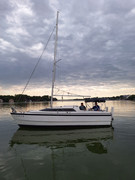
To be honest, when we installed the A/C I’d done a reasonable weight and balance exercise counting on our inflatable dinghy.
For most of our travels we’ve removed the inflatable dinghy from the boat as we found it rather more than awkward to use and row.
(If/when we get that trolling motor we’ll probably get more enjoyment and use out of it.)
It’s also rather bulky, heavy and awkward to move around.
(When installing the A/C and fridge I had originally counted on it as being the starboard counter balance but it really was just adding dead weight and taking up space most of the time…)
If/when we ever get a an electric trolling motor (and dedicated battery) for our inflatable dinghy I’d mount its stowage location to the starboard side back wall of the head to help balance out the A/C unit and Thermionic fridge.

Things evolve and things get adapted… it’s all part of the game :wink: :D

Best Regards,
Over Easy 8) 8)
Post Reply