

I finally ordered my 26M last week. I have been discussing with my dealer that since I want to rig the boat for single handed sailing I will need to lead all the lines aft. He proposed to lead four lines back to the cockpit (if I remember correctly: main halyard, toppling lift and two reefing lines).
I did a search and I found a few posts about this, but all of them are about the main halyard. I have the following questions:
- Do you typically move all the lines aft, or only the halyard is really necessary for single handed sailing.
- Would you use just cleats, cam cleats or clutches?
- Any problems with the rotating mast?
- Would you lead all of the lines on the same side?
- What about the boom vang line?
Since sometimes I will be sailing with my son, I would like to minimize the number of times I need to go on the deck. I would be very interested to hear what you have done with your boats.
Thank you all in advance,
Vassilis
Single handed sailing - all lines aft
-
bjtaksa

- Just Enlisted
- Posts: 11
- Joined: Wed Mar 23, 2005 5:13 am
- Location: Denver, NC (Lake Norman) 2006 26M - Suzuki 50 "Independence"
- Contact:
Congrats on the new boat!
I have a 06 26M I bought from Boats4Sail. Bill installs 4 lines running aft, two per side. They run through clutches (2 paired clutches). On the starboard is the main halyard and daggerboard. Port has the jib halyard and the headsail downhaul. Works well for singlehanding. No problems with the rotating mast (I highly recommend lubricating the washers of the rotating mast). My boom vang is not run aft, but the line is long enough to work from the cockpit.
Hope this helps.
Brandon
I have a 06 26M I bought from Boats4Sail. Bill installs 4 lines running aft, two per side. They run through clutches (2 paired clutches). On the starboard is the main halyard and daggerboard. Port has the jib halyard and the headsail downhaul. Works well for singlehanding. No problems with the rotating mast (I highly recommend lubricating the washers of the rotating mast). My boom vang is not run aft, but the line is long enough to work from the cockpit.
Hope this helps.
Brandon
Re: Single handed sailing - 17 lines aft
vassilis wrote:I finally ordered my 26M last week. I have been discussing with my dealer that since I want to rig the boat for single handed sailing I will need to lead all the lines aft. He proposed to lead four lines back to the cockpit (if I remember correctly: main halyard, toppling lift and two reefing lines).
I did a search and I found a few posts about this, but all of them are about the main halyard. I have the following questions:
- Do you typically move all the lines aft, or only the halyard is really necessary for single handed sailing.
- Would you use just cleats, cam cleats or clutches?
- Any problems with the rotating mast?
- Would you lead all of the lines on the same side?
- What about the boom vang line?
In general, I think the arrangement of the lines and controls is a matter of personal preference, but I don't think they should all be crowded on one side. On my boat, I count 17 lines either led aft or already terminated at the cockpit, and I'm beginning to think I should color-code at least some of them. My boat has roller furling and a two-line reefing system, so some of the lines on mine may not be applicable to yours.
As an example, on our boat, the lines terminating in the cockpit are:
(for the mainsail)
main halyard
mainsheet (On starboard side, terminated in a cleat)
port and starboard traveler adjustment lines (in cam cleats)
topping lift
outhaul
vang
reefing lines connected near luff and leach of main, led aft on port side
(for the jib)
starbord and port jibsheets (on starboard and port, respectively, and terminated in cam cleats)
roller furling "retraction line" (for pulling in the jib - terminated in a small cleat on port side)
Dagger board retraction line (on starboard, terminated in a cleat)
(Rudders)
port and starboard lines for pulling up port and starboard rudders
port and starboard lines for deploying rudders
I may have missed some, and the above list doesn't include the docking lines (which, of course, should be kept handy, untangled and ready for use), lines for adjusting a bimini, lines holding the bumper, normally pulled in when underway. Other controls include controls for the the motor and electrical systems, such as autopilot, chartreader, etc. Also, don't forget to check the valve controls for the ballast intake and vent valves (as I have). - Summarizing, I think operating the Mac 26 is somewhat more complicated than operating many larger keel boats in which you normally don't have to worry about whether a ballast tank is filled and the valves closed, whether the rudders are up or down, how the daggerboard is set, etc. But to me, it all adds to the fun and versatility of the boat.
While all this might seem complicated, only a few of the lines are used frequently while sailing. After the rudders and daggerboard are set, the motor raised and the reefing systems, etc., adjusted appropriately, you will usually have to concern yourself only with the mainsheet, traveller, and jibsheets, just as on most sloops. - Particularly for single-handed sailing, in my opinion all of these lines should be handy to the skipper and releasably secured in camcleats to permit quick release and convenient adjustment during tacking and the like. I normally hold both jibsheets loosely when beginning a tack, releasing the (formerly) leeward sheet only after the bow crosses the wind.
Jim

-
Scott

- Admiral
- Posts: 1654
- Joined: Tue May 18, 2004 12:46 pm
- Sailboat: Venture 25
- Location: 1978 Catalina 22 with all the Racing Goodies!! 4 horse fire breathing monster on the transom
Read most of my take on it here
After many years of mac ownership I took the plunge
A couple things I would or am going to change are: I would run a mainsail lowering downhaul as the main will not drop reliably, and if I were running a hank on jib the halyard and a downhaul would be in the cards but I have a furler.
I did run my vang back and love it that way. Way more useable. (I are a english major)
Be very careful or you will just garbage up your cockpit. When I did this I order most of my stuff through bill and he questioned the wisdom of lazy jacks due to the small size of the sail. I didnt nec agree at the time but do now. You can bungee the sail out of the way from the cockpit and flake it back at the dock.
After many years of mac ownership I took the plunge
A couple things I would or am going to change are: I would run a mainsail lowering downhaul as the main will not drop reliably, and if I were running a hank on jib the halyard and a downhaul would be in the cards but I have a furler.
I did run my vang back and love it that way. Way more useable. (I are a english major)
Be very careful or you will just garbage up your cockpit. When I did this I order most of my stuff through bill and he questioned the wisdom of lazy jacks due to the small size of the sail. I didnt nec agree at the time but do now. You can bungee the sail out of the way from the cockpit and flake it back at the dock.
-
MAC26X

- Chief Steward
- Posts: 89
- Joined: Fri Dec 31, 2004 12:57 pm
- Location: Sandusky, OH 2001 Mac26X Anne Marie Honda 50
I agree with not overcomplicating things. We have the following lines led aft:
- main halyard and jib halyard on starboard side through clutches.
- centerboard line on starboard to a jam cleat.
- Main downhaul to starboard side- no cleat, just a velcro line tender.
- Furler on port side to a jam cleat.
- Remainder of port side is free and uncluttered to go on deck.
- Topping lift adjustment and jam cleat is at the rear of the boom, easily reached from the cockpit.
Next step:
I'm adding a 2 line jiffy reefing- both lines will run to jam cleats at the aft of the boom, keeping the deck clean. They are easily reached from the cockpit.
- main halyard and jib halyard on starboard side through clutches.
- centerboard line on starboard to a jam cleat.
- Main downhaul to starboard side- no cleat, just a velcro line tender.
- Furler on port side to a jam cleat.
- Remainder of port side is free and uncluttered to go on deck.
- Topping lift adjustment and jam cleat is at the rear of the boom, easily reached from the cockpit.
Next step:
I'm adding a 2 line jiffy reefing- both lines will run to jam cleats at the aft of the boom, keeping the deck clean. They are easily reached from the cockpit.
-
Dimitri-2000X-Tampa

- Admiral
- Posts: 2043
- Joined: Fri Jan 02, 2004 5:36 am
- Sailboat: MacGregor 26X
- Location: Tampa, Florida 2000 Mercury BigFoot 50HP 4-Stroke on 26X hull# 3575.B000
Yasou Vassilis and welcome to the Mac community. I have a 26X so not quite the same but I have been trying to improve the sail controls over time. I have a 3:1 outhaul but it doesn't go through the boom so I have to stand up and adjust it off the end of the boom. I also have a 3:1 backstay adjuster but that is not relevant to the 26M. I'm not sure why so many folks have a topping lift run to the cockpit unless you are talking about a topping lift for a spinnaker pole which would require some modification to the mast to accomplish. My topping lift which holds the boom up is pretty much stationary. As long as I have my vang and main sheet released, the main sail pulls the boom up higher and holds it up and when I release the main halyard, the topping lift takes it again. I've thought about adding a cunningham and some other stuff, but it is low on my priority list.
I never have had problem with my mainsail coming down (with slugs) so I've never thought I needed a downhaul for that. I don't use any lubrication because I think it will eventually gunk up the track.
Since I have a furler, I have only been using my jib halyard for mast raising but now that I'm in the process of learning how to use an asym spin on the boat, I can see that I need to get a longer jib halyard so I can run it back through the clutch where I have my main halyard.
Here is a good article about leading lines aft http://www.sailnet.com/collections/arti ... suelar0189
One thing about the Mac that I would like to improve is the color coding of the lines, my stock Mac came with white everything except for the CB line which was the stock blue line. I have since replaced that with a black line. Black probably makes good sense for a CB line.
I have not seen a good authority on what colors different lines should be but I'm thinking about going with blue for a new jib halyard now that that color is not in use anymore. If I remember my last sail boat, it had a blue jib halyard, a red main halyard, and a green reefing line. New halyards are not particularly inexpensive so I haven't replaced any yet but I will definitely put the colored ones in when i do. Also, I don't have any reefing lines at this point but that kind of has the same issue as the outhaul, I think you have to run it through the boom and that could be a problem on a 26X.
I never have had problem with my mainsail coming down (with slugs) so I've never thought I needed a downhaul for that. I don't use any lubrication because I think it will eventually gunk up the track.
Since I have a furler, I have only been using my jib halyard for mast raising but now that I'm in the process of learning how to use an asym spin on the boat, I can see that I need to get a longer jib halyard so I can run it back through the clutch where I have my main halyard.
Here is a good article about leading lines aft http://www.sailnet.com/collections/arti ... suelar0189
One thing about the Mac that I would like to improve is the color coding of the lines, my stock Mac came with white everything except for the CB line which was the stock blue line. I have since replaced that with a black line. Black probably makes good sense for a CB line.
I have not seen a good authority on what colors different lines should be but I'm thinking about going with blue for a new jib halyard now that that color is not in use anymore. If I remember my last sail boat, it had a blue jib halyard, a red main halyard, and a green reefing line. New halyards are not particularly inexpensive so I haven't replaced any yet but I will definitely put the colored ones in when i do. Also, I don't have any reefing lines at this point but that kind of has the same issue as the outhaul, I think you have to run it through the boom and that could be a problem on a 26X.
I use Bill@B4S's "EZ-Cleats" for my headsail sheets. This frees up the cam-cleats at the winches.
I have both a halyard and down haul for the mainsail run aft along the starboard side. Whichever one needs tension is cleated with the cam-cleat on that side. Only one needs to be cleated at a time. Also, my halyard and down haul are the same line (in a loop), so I don't have to worry about the other just flying off...
I have both a halyard and down haul for the headsail run aft along the port side, using the cam-cleat on that side just like for the mailsail. Its also a loop.
I don't yet have a reefing setup led aft. I will, eventually, but just haven't yet...
My setup is pretty easy and relatively cheap... You just need a handful of blocks and longer line. The mainsail, with downhaul, requires 2 double blocks and ~100'. The mainsail's downhaul is not real useful, so you could get by without it, using only two single blocks. The headsail, with downhaul, requires two singles, one double, and ~100'. The headsail downhaul is real handy...
I have both a halyard and down haul for the mainsail run aft along the starboard side. Whichever one needs tension is cleated with the cam-cleat on that side. Only one needs to be cleated at a time. Also, my halyard and down haul are the same line (in a loop), so I don't have to worry about the other just flying off...
I have both a halyard and down haul for the headsail run aft along the port side, using the cam-cleat on that side just like for the mailsail. Its also a loop.
I don't yet have a reefing setup led aft. I will, eventually, but just haven't yet...
My setup is pretty easy and relatively cheap... You just need a handful of blocks and longer line. The mainsail, with downhaul, requires 2 double blocks and ~100'. The mainsail's downhaul is not real useful, so you could get by without it, using only two single blocks. The headsail, with downhaul, requires two singles, one double, and ~100'. The headsail downhaul is real handy...
-
delevi

- Admiral
- Posts: 2184
- Joined: Fri May 06, 2005 1:03 am
- Location: San Francisco Catalina 380, former 26M owner
- Contact:
The main halyard aft, in my opinion is the most important. I also ran my topping lift aft. With RF, of course, the furling line will run aft to the cockpit. I also have two reefing lines set up, one for each reef point, but this only controls the reefing clews. I still need to go up on deck to drop two or four slugs, depending on the reef, and secure the reefing tack to the hook. I sometimes wish I had single line reefing, but I never sail reefed with the unused sail just hanging. I always roll it up and tie off with reefing diamonds, so since I'm going on deck anyway, setting up the new tack isn't that big a deal. I use clutches for the main halyard and db line (mine is modified, weighing 170 lbs.) Both lines on the starboard side. On the port side, I have my furling line, and topping lift (secured to the stock cleat already on deck,) furling line has a jam cleat installed by the dealer. Both reefing lines secure on the boom with regular cleats. If properly done, the main halyard running aft won't cause any problems with mast rotation. The key is to have a swivel block near the base of the mast. I Don't have the experience with a downhaul, since I don't have one and my vang isn't run aft, but I can reach it by leaning over the cabin top. Hope this helps.
Leon
Leon
-
Dan B

- First Officer
- Posts: 209
- Joined: Wed Jan 07, 2004 12:54 pm
- Location: Cary, NC "Mystic" 1999 26x Yamaha F50
I have the following led aft -
1) Main halyard
2) Jib sheets
3) Downhaul
4) Single reefing line
5) Furling line
I hate a cluttered cockpit and think it can get dangerous. So all lines except sheets are tied around the stanchions or boom bails, ready for use should the need arise.
I left the vang forward as I can reach it by standing in the companion way.
1) Main halyard
2) Jib sheets
3) Downhaul
4) Single reefing line
5) Furling line
I hate a cluttered cockpit and think it can get dangerous. So all lines except sheets are tied around the stanchions or boom bails, ready for use should the need arise.
I left the vang forward as I can reach it by standing in the companion way.
Lines Aft
My number 1 priority was jib (port) and main (starboard) halyards (no roller furler). They run through jammers forward of the respective winches. Topping lift is run to port. If you locate the swivel blocks in line with the bolt at the mast base leverage is minimal under tension and the mast rotates OK. I used 2 stacked cheek blocks rather than standard turning blocks to minimise clutter on the deck + keep the stubbed toe rate down!
I played around with downhauls but found they were more lines to get tangled + usually had to go forward anyway to bungee the jib + main to stop them going over the side (you can stand on the V berth for greater safety if it's choppy - the Mac's high freeboard keeps the foredeck well out of the water). With slugs on the main + a lubed track the main drops with a couple of tugs from the cockpit.
I have premarked the main halyard to indicate Reef 1 + 2. To reef I drop the main to the pre marked point at the jammer, go forward and hook the cringle over the horn and tension the clew line. (I have a line for each reef point, which run forward on each side of the boom to a small jammer at the forward end). I then tension the halyard on the winch. The bunt (loose bit of sail) is gathered around the boom. Takes a couple of minutes once you get the hang of it.
I often sail single handed and find this system works well. Can get both sails up + underway in a couple of minutes.
Cheers,
AJ
I played around with downhauls but found they were more lines to get tangled + usually had to go forward anyway to bungee the jib + main to stop them going over the side (you can stand on the V berth for greater safety if it's choppy - the Mac's high freeboard keeps the foredeck well out of the water). With slugs on the main + a lubed track the main drops with a couple of tugs from the cockpit.
I have premarked the main halyard to indicate Reef 1 + 2. To reef I drop the main to the pre marked point at the jammer, go forward and hook the cringle over the horn and tension the clew line. (I have a line for each reef point, which run forward on each side of the boom to a small jammer at the forward end). I then tension the halyard on the winch. The bunt (loose bit of sail) is gathered around the boom. Takes a couple of minutes once you get the hang of it.
I often sail single handed and find this system works well. Can get both sails up + underway in a couple of minutes.
Cheers,
AJ
single handed sailing, lines led aft
I have a 26x and I changed out all my original lines except the main sheet. I color coded each line to make it easier for others that may sail with me to be able to operate the right line by just looking at the color. Especially if things get busy. I have a blue main halyard on the starboard side running aft through clutches, and a red line (for emergencies) for the reefing line also running to a clutch on the starboard side. The jib is green on the port side and the topping lift is black also on the port side running through clutches. I use Bills easy cleats for the jib sheets and the main stays the same as it was. I would like to put the vang running aft, but haven't gotten to that yet. I put all the loose line in a bag on in the cockpit on the port and starboard side, but would like to find a better way for that still.
-
LOUIS B HOLUB
- Admiral
- Posts: 1315
- Joined: Wed Oct 19, 2005 7:40 am
- Location: 1999 Mac-X, Nissan 50 HP, Kemah, TX, "Holub Boat"


-
Scott
- Admiral
- Posts: 1654
- Joined: Tue May 18, 2004 12:46 pm
- Sailboat: Venture 25
- Location: 1978 Catalina 22 with all the Racing Goodies!! 4 horse fire breathing monster on the transom
I had discussed in the prev thread I posted on this the problem with so many line tailings in the cockpit.
I ran my spin sheets to the aft ralings and used velcro.Frank I tried the hoopti loopti super stow that you tried to explain but I think Im still gonna make SS Shooks to clipon the railings for this.
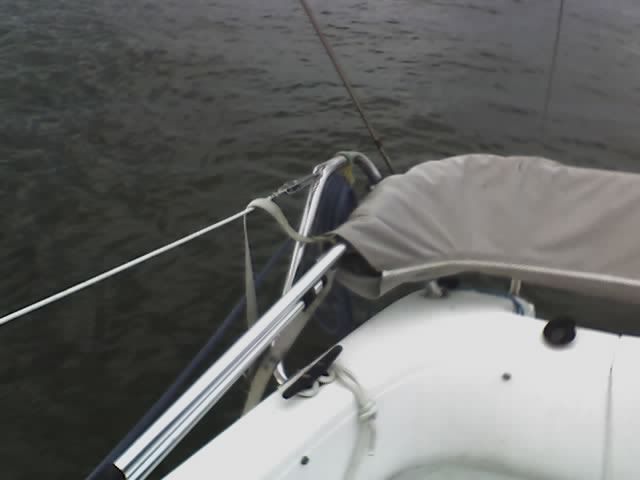
Used velcro here too but not so good.
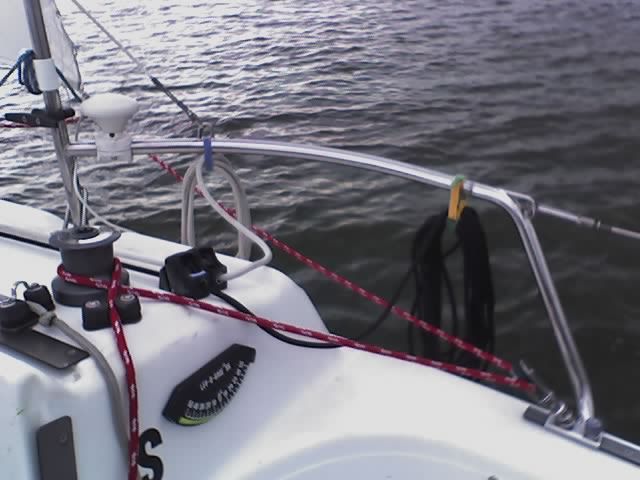
I ran my spin sheets to the aft ralings and used velcro.Frank I tried the hoopti loopti super stow that you tried to explain but I think Im still gonna make SS Shooks to clipon the railings for this.
Used velcro here too but not so good.
-
Frank C
Scott - you sure sail a bunch "neater" than I do ... gotta agree though that those hip rails on the X are sure handy! And though I don't subscribe to the "need" for them, I did buy some gadgets at the boatshow that you'd love to have, in lieu of those SS-hooks (I'm not metals-handy). I'll post a picture for you soon. (p.s. also found that same Lev-o-Gage in WM a few weeks back - it's perfect!)
Regarding the original question, I have but one observation: Rope-on-deck is rope-a-dope.
Try to arrange your lines aft to leave the side decks clear because you will inevitably need to go on deck. When you step on any rope you ARE risking a fall, especially when the boat is heeled.
After many years with my lines aft I'm still satisfied that I ran them along the rails for sliding hatch. And viewing some other ideas in these pages, looks to me like cleating those halyards right at the mast is a good way to reduce "lines-on-deck." The number of good reasons to have halyards in the cockpit? ... somewhere between zero and none, even for the 26X'ers. (I'd have them tailing across the slider and into the cabin.)
(Photo courtesy of aya16 & TT, [both Mikes])

Regarding the original question, I have but one observation: Rope-on-deck is rope-a-dope.
Try to arrange your lines aft to leave the side decks clear because you will inevitably need to go on deck. When you step on any rope you ARE risking a fall, especially when the boat is heeled.
After many years with my lines aft I'm still satisfied that I ran them along the rails for sliding hatch. And viewing some other ideas in these pages, looks to me like cleating those halyards right at the mast is a good way to reduce "lines-on-deck." The number of good reasons to have halyards in the cockpit? ... somewhere between zero and none, even for the 26X'ers. (I'd have them tailing across the slider and into the cabin.)
(Photo courtesy of aya16 & TT, [both Mikes])
Last edited by Frank C on Sun Jul 09, 2006 10:19 am, edited 1 time in total.
-
RandyMoon

- Captain
- Posts: 779
- Joined: Mon Sep 13, 2004 7:05 pm
- Sailboat: MacGregor 26M
- Location: Rockwall, TX Lake Ray Hubbard 2005M #0690 L405 Tohatsu TLDI 90 (Rhapsody in Blue)
I just added a MOD to the MOD pages showing how I ran my vang line aft to the cockpit this morning. It works really well.
Now I have the halyard, vang, daggerboard, furler and jib lines all running back to the cockpit.
MOD - http://www.macgregorsailors.com/cgi-bin ... record=689

 [/url]
Now I have the halyard, vang, daggerboard, furler and jib lines all running back to the cockpit.
MOD - http://www.macgregorsailors.com/cgi-bin ... record=689
[/url]