

Leon
I understand what you are tying to do and it would help and your comment about situation awareness hit a raw nerve with me. At the end of last season I was amber ling to the ramp to pull her out of the water, rudders down and the dagger board down about a third here is my error I didn’t have the sonar on and just over the sound of Meatloaf I could hear the sound of breaking fiberglass then it went away it only lasted a few seconds as I was solo I pressed on before investigating. On the shore I walked around and around her and discovered that the starboard rudder rope had cut a neat slot about ½ inch long in the deck exit hole funny enough there was no feed back through the helm.
Jack Sparrow
Ps have I missed something I pull the rudders down then cleat them to keep them there
Rudders past limits: Snap! Pop!
-
Jack Sparrow

- Engineer
- Posts: 137
- Joined: Mon Apr 02, 2007 7:00 pm
- Sailboat: MacGregor 26M
- Location: Cairns, Australia 2007 M 50 Yamaha Run to Paradise
-
Frank C
Leon,
I understood it too ... bolt 'em down only for sailing. Your post was perfectly clear.
But my comment was as counterpoint (mostly unstated):
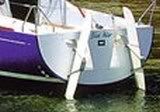
Finally, Eric posted following picture some weeks ago. Roger could have designed slide-brackets instead of swing-brackets, making them more like the daggerboard. But he was prolly thinking of his primary market (we 'novice' sailors) and I appreciate it ... "on the rocks" twice last month~!
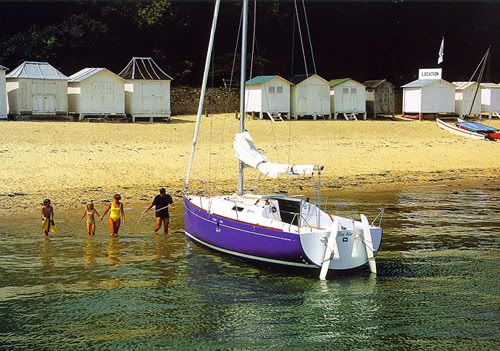 .
.
I understood it too ... bolt 'em down only for sailing. Your post was perfectly clear.
But my comment was as counterpoint (mostly unstated):
- 1. You lose their swing-up safety valve during a grounding (sounds as if Jack's rudders refused, anyhow);
2. Should you hit an obstruction, that IDA blade is a lot greater loss than the Roger-version;
3. And, if you ever felt disconnecting your engine was a 'sailing hassle' just wait till you try bolting-down those rudders (without swimming).
Finally, Eric posted following picture some weeks ago. Roger could have designed slide-brackets instead of swing-brackets, making them more like the daggerboard. But he was prolly thinking of his primary market (we 'novice' sailors) and I appreciate it ... "on the rocks" twice last month~!
.-
delevi

- Admiral
- Posts: 2184
- Joined: Fri May 06, 2005 1:03 am
- Location: San Francisco Catalina 380, former 26M owner
- Contact:
Frank,
Well it puts me on even par with a regular sailboat. I figure I have a far lesser chance of grounding than experience a similar situation when the rudder failed. The board would probably hit before the rudders anyhow. Disconnecting the engine with the BWY system is a breeze (5 seconds) I did a test trial, reaching to the brackets as though to bolt them and you're right. PITA. Not as bad if I lay on the outboard face down. Still, probably a 2 minute prep which can be done while the ballast tank fills. Wouldn't bother with it on mild days. I remember a while back hitting rocks in Lake Tahoe with my rudders. They trailed a bit but didn't kick up. Raised the stern a foot or two and then came down. Koodos to Roger's rudders in this instance. Just minor damage at the tips which I was able to fix with some gelcoat and sanding. The IDA rudders would have most likely broken, but again, would have done so with bolt or just secured by the lines.
Hey, what happend with the "on the rocks scenario?" Do tell.
Jack,
Yes the lines hold the rudders down, but there will always be a little bit of trailing now and again, no matter how tight the lines are secured. Rope bends easily and ther is enough run through the rudder tubes to allow for that to happen, at least in my experience.
Leon
On edit:
What's that purple boat? Looks nice. Not sure about the rudders pointing outward. I assume by desgin but can't figure out why.
Well it puts me on even par with a regular sailboat. I figure I have a far lesser chance of grounding than experience a similar situation when the rudder failed. The board would probably hit before the rudders anyhow. Disconnecting the engine with the BWY system is a breeze (5 seconds) I did a test trial, reaching to the brackets as though to bolt them and you're right. PITA. Not as bad if I lay on the outboard face down. Still, probably a 2 minute prep which can be done while the ballast tank fills. Wouldn't bother with it on mild days. I remember a while back hitting rocks in Lake Tahoe with my rudders. They trailed a bit but didn't kick up. Raised the stern a foot or two and then came down. Koodos to Roger's rudders in this instance. Just minor damage at the tips which I was able to fix with some gelcoat and sanding. The IDA rudders would have most likely broken, but again, would have done so with bolt or just secured by the lines.
Hey, what happend with the "on the rocks scenario?" Do tell.
Jack,
Yes the lines hold the rudders down, but there will always be a little bit of trailing now and again, no matter how tight the lines are secured. Rope bends easily and ther is enough run through the rudder tubes to allow for that to happen, at least in my experience.
Leon
On edit:
What's that purple boat? Looks nice. Not sure about the rudders pointing outward. I assume by desgin but can't figure out why.
-
delevi
- Admiral
- Posts: 2184
- Joined: Fri May 06, 2005 1:03 am
- Location: San Francisco Catalina 380, former 26M owner
- Contact:
That is a nice boat Eric. Thanks for the link. I think I will still use a 1/4" bolt with loop on one end and wing nut w/ lock washer on the other so I can get a bit of tension on the lower part of the bracket. I'll see if I can deal with the extra effort of dealing with the bracket bolts after a few outings. I think if I hit someting, the rudder(s) will go before anything else, unless I first hit the daggerboard and then who knows  Will have to make use of that blue chart software I installed on the GPS.
Will have to make use of that blue chart software I installed on the GPS.-
Frank C
Eric,
Roger has designed-in your safety valve. A no-stretch line will just crack/break thru the transom's plastic padeye. Many here have experienced this already, the padeye 'just breaks' in a hard grounding. If you're queezy about it you can slice halfway thru the padeye with a hacksaw, guaranteed fail-safe.
Leon,
Your's is clearly a different issue, trying to guarantee true stability of the blade. Your approach is totally valid. SF Bay is deep in the good sailing areas. The hassle of bolting them for sailing, then reversing for retrieval ... that's just the price of good sailing.
Roger could very easily have designed a "swinging-clamping" rudder bracket... I can picture it now ... at about double the cost. Wonder why he didn't? ....
Roger has designed-in your safety valve. A no-stretch line will just crack/break thru the transom's plastic padeye. Many here have experienced this already, the padeye 'just breaks' in a hard grounding. If you're queezy about it you can slice halfway thru the padeye with a hacksaw, guaranteed fail-safe.
Leon,
Your's is clearly a different issue, trying to guarantee true stability of the blade. Your approach is totally valid. SF Bay is deep in the good sailing areas. The hassle of bolting them for sailing, then reversing for retrieval ... that's just the price of good sailing.
Roger could very easily have designed a "swinging-clamping" rudder bracket... I can picture it now ... at about double the cost. Wonder why he didn't? ....