

I have been following the thread about dinghy's in the Powersailer section. I wanted to ask a question in regards to towing behind my 26s. We have owned several inflatables of various size and capacity that we used with our powerboats...some towed, some carried on top. For the 26s I am leaning towards a 10-11' inflatable and will use the 3.5 HP Merc from our Windrider for the power.
So...generally speaking... how much drag do these have (with powerboats that never really mattered)? Given the same conditions while sailing what kind of speed decrease would one expect while towing a dinghy? Thanks.
Towing a Dinghy Behind a Classic
-
Herschel

- Admiral
- Posts: 1487
- Joined: Wed Sep 28, 2005 4:22 pm
- Sailboat: MacGregor 26X
- Location: Orlando, Florida
- Contact:
Re: Towing a Dinghy Behind a Classic
I can only provide my experience towing a 10 ft. dinghy while motoring my 26X. My dinghy I used before I got my inflatable was a fiberglass O'Day Sprite that weighed in at about 225 lbs. I found that when motoring at my cruising speeds of between 8-10 knots, if I kept the dinghy on the front/down sloping section of the wake wave, there was negligible drag, and I found very little impact on fuel economy. I have not, yet, had occasion to tow my new inflatable dinghy (Achilles LT-4) behind my 26X. I did share a week with family on a 40-ft keel sailboat in the BVI some years back, and we towed an inflatable Zodiac behind us all week under sail, and it was hardly even noticeable. My guess is that they are so light they pose very little drag, but length of tow line and wake positon might still be a small factor. I do use a sail rig on my Achilles for teaching sailing to kids and for travel with my RV. I find that it sails along pretty well with two adults suggesting not too much drag even loaded; I would suspect very little drag empty. I think I have seen posts on this forum about members actually having their towed inflatables overturned in high winds, again suggesting very little drag.what kind of speed decrease would one expect while towing a dinghy? Thanks.


Re: Towing a Dinghy Behind a Classic
Depends on if it is a displacement or planing hull dingy. If it is a displacement hull it will slow you down to the speed of the shorter water line. If it is a planing hull once it gets on plane it will acually speed you up. 
-
FlyboyTR

- Engineer
- Posts: 153
- Joined: Thu Nov 19, 2015 3:33 pm
- Sailboat: MacGregor 26S
- Location: Mobile, AL
Re: Towing a Dinghy Behind a Classic
Herschel,Herschel wrote:I can only provide my experience towing a 10 ft. dinghy while motoring my 26X. My dinghy I used before I got my inflatable was a fiberglass O'Day Sprite that weighed in at about 225 lbs. I found that when motoring at my cruising speeds of between 8-10 knots, if I kept the dinghy on the front/down sloping section of the wake wave, there was negligible drag, and I found very little impact on fuel economy. I have not, yet, had occasion to tow my new inflatable dinghy (Achilles LT-4) behind my 26X. I did share a week with family on a 40-ft keel sailboat in the BVI some years back, and we towed an inflatable Zodiac behind us all week under sail, and it was hardly even noticeable. My guess is that they are so light they pose very little drag, but length of tow line and wake positon might still be a small factor. I do use a sail rig on my Achilles for teaching sailing to kids and for travel with my RV. I find that it sails along pretty well with two adults suggesting not too much drag even loaded; I would suspect very little drag empty. I think I have seen posts on this forum about members actually having their towed inflatables overturned in high winds, again suggesting very little drag.what kind of speed decrease would one expect while towing a dinghy? Thanks.
Thanks for the feedback. I have never considered a dinghy being overturned due to high winds!
-
FlyboyTR
- Engineer
- Posts: 153
- Joined: Thu Nov 19, 2015 3:33 pm
- Sailboat: MacGregor 26S
- Location: Mobile, AL
Re: Towing a Dinghy Behind a Classic
Grady,grady wrote:Depends on if it is a displacement or planing hull dingy. If it is a displacement hull it will slow you down to the speed of the shorter water line. If it is a planing hull once it gets on plane it will acually speed you up.
I can't conceive any inflatable having a displacement hull...but I guess it is possible; but...I guess all hulls are displacement (to some degree) depending on the speed at which they are moving.
 So... I would say that what I am wanting to buy would be considered a planing hull. So possibly the faster we are sailing the more efficient the dinghy becomes; in relation to drag.
-
Sumner

- Admiral
- Posts: 2375
- Joined: Sun Jan 04, 2009 3:20 pm
- Sailboat: MacGregor 26S
- Location: SE Utah
- Contact:
Re: Towing a Dinghy Behind a Classic
I've towed a 9 foot Zodiac with the inflatable keel behind the 26S for hundreds of miles everywhere the Mac has gone. I'm sure it decreases speed some and effects gas mileage some as it is drag. I've still averaged about 10 mpg with the old Honda 8 HP and the newer Tohatsu 9.8 towing usually about 5 mph but could tow at hull speed if I wanted to run the outboard that hard.
I use to tow it from the bow rings but now tow it with a strap going back to a bridle on the transom. I feel in some conditions I might of pulled out the bow rings on the last trip. Pulling from the stern...

...also keeps the inflatable flatter on the water helping to pull the nose down......

....and keeps all the stress off of those bow rings.
99% of the time the dinghy is pulled up to the horizontal ladder that acts as a tow bar...
http://purplesagetradingpost.com/sumner ... de-17.html
..... and that keeps it in close and out of trouble. No line getting tangled up in the prop and such. I did have a few days on the last trip with large following waves that were picking it up and running it into the ladder so I then let it out 40-50 feet behind the Mac.
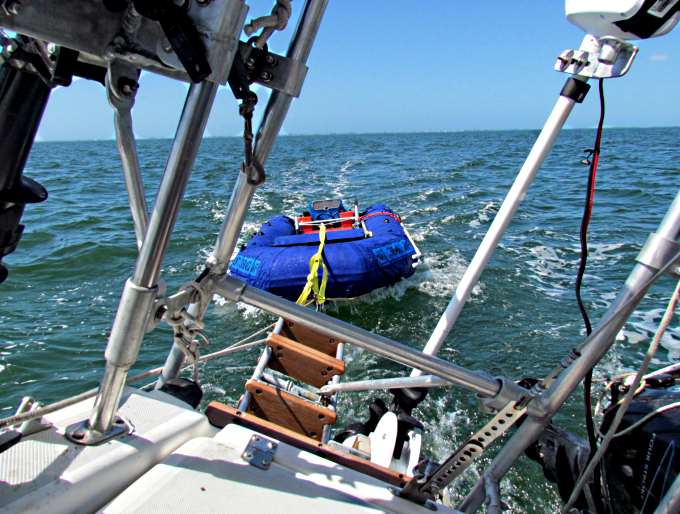
I run a second tow line to it always just in case something happened with the main one as sometimes I'll go a ways without looking back at it and don't want to find it gone some time.
Here is a link to a video showing that it doesn't effect the Mac all that much. I had the boat fully loaded with over 1200 lbs. of supplies and the two of us in the boat for the day and towing the dinghy and still managed over 6 mph sailing. On the trip I saw speeds over 7 before it rounded up and consistent high 6 mph speeds,
Video: https://www.youtube.com/watch?v=ppZV4NR ... e=youtu.be
More on the day here....
http://1fatgmc.com/boat/mac-1/2015%20Ba ... age-1.html
Sumner
============================
1300 miles to the Bahamas and back -- 2015
The MacGregor 26-S
The Endeavour 37
Trips to Utah, Idaho, Canada, Florida
Mac-Venture Links
I use to tow it from the bow rings but now tow it with a strap going back to a bridle on the transom. I feel in some conditions I might of pulled out the bow rings on the last trip. Pulling from the stern...
...also keeps the inflatable flatter on the water helping to pull the nose down......
....and keeps all the stress off of those bow rings.
99% of the time the dinghy is pulled up to the horizontal ladder that acts as a tow bar...
http://purplesagetradingpost.com/sumner ... de-17.html
..... and that keeps it in close and out of trouble. No line getting tangled up in the prop and such. I did have a few days on the last trip with large following waves that were picking it up and running it into the ladder so I then let it out 40-50 feet behind the Mac.
I run a second tow line to it always just in case something happened with the main one as sometimes I'll go a ways without looking back at it and don't want to find it gone some time.
Here is a link to a video showing that it doesn't effect the Mac all that much. I had the boat fully loaded with over 1200 lbs. of supplies and the two of us in the boat for the day and towing the dinghy and still managed over 6 mph sailing. On the trip I saw speeds over 7 before it rounded up and consistent high 6 mph speeds,
Video: https://www.youtube.com/watch?v=ppZV4NR ... e=youtu.be
More on the day here....
http://1fatgmc.com/boat/mac-1/2015%20Ba ... age-1.html
Sumner
============================
1300 miles to the Bahamas and back -- 2015
The MacGregor 26-S
The Endeavour 37
Trips to Utah, Idaho, Canada, Florida
Mac-Venture Links
-
FlyboyTR
- Engineer
- Posts: 153
- Joined: Thu Nov 19, 2015 3:33 pm
- Sailboat: MacGregor 26S
- Location: Mobile, AL
Re: Towing a Dinghy Behind a Classic
Sumner,
Thanks for the first hand info regarding your towing of a dinghy. I always enjoy your posts, pictures and stories. I also like moving the pulling forces to the stern of the dinghy and using a bridle to keep things pointed in the right direction. Good thinking!
I have found a 10' hard bottom Avon for $150...sort of the deal of the day...but my concern in being able to easily transport it when we are trailering the boat to a remote launch area. I may have to buy that just to keep on our dock. I have also found an 11' inflatable that is newer and still with my cheap price range. It would be easier to transport if needed.
Thanks again for the info and links. I have also subscribed to your YouTube channel.
Thanks for the first hand info regarding your towing of a dinghy. I always enjoy your posts, pictures and stories. I also like moving the pulling forces to the stern of the dinghy and using a bridle to keep things pointed in the right direction. Good thinking!
I have found a 10' hard bottom Avon for $150...sort of the deal of the day...but my concern in being able to easily transport it when we are trailering the boat to a remote launch area. I may have to buy that just to keep on our dock. I have also found an 11' inflatable that is newer and still with my cheap price range. It would be easier to transport if needed.
Thanks again for the info and links. I have also subscribed to your YouTube channel.
-
FlyboyTR
- Engineer
- Posts: 153
- Joined: Thu Nov 19, 2015 3:33 pm
- Sailboat: MacGregor 26S
- Location: Mobile, AL
Re: Towing a Dinghy Behind a Classic
I have begun using a small air mattress pump to purge the ballast tank for putting the boat on the trailer...much easier (IMO). Considering how unstable the boat is without ballast...I don't think I would attempt to operate it as a dinghy. Without ballast and using two people, we were able to roll the boat to the point that it would not self-right (did this at the dock...just had to know) I believe it would be way to dangerous to try and use the boat, in any capacity, without water in the tank.Plebian wrote:Install a ballast pump and a Mac is a dinghy....
If I were hard aground and felt that blowing the ballast would allow me to pull or push the boat off...I would do that. But, as soon as it was unstuck, we would be filling the ballast tanks before getting underway. Again...just my opinion. I am new to this boat and my knowledge is limited...but I have proved to myself how unstable it is without any water in the ballast tank. Thanks!
-
Starscream

- Admiral
- Posts: 1561
- Joined: Tue Nov 03, 2009 10:08 am
- Sailboat: MacGregor 26X
- Location: Montreal, Quebec. 2002 26X - Suzi DF90A
Re: Towing a Dinghy Behind a Classic
I used to think this, but after some years of using the boat I disagree. With no ballast, I motor at 24 mph, hard turns = no prob, hole shot at full throttle with motor fully turned = no problem and lots of fun. 2 foot waves = no problem. One time last year a jetski came over to jump my wake, so I spun around and jumped his and we started doing figure eights and put on a good Mac show.FlyboyTR wrote: I believe it would be way to dangerous to try and use the boat, in any capacity, without water in the tank.
I was sailing with some buddies last year, and I accidentally left the ballast valve open. In relatively light winds, let's say 10 knots or less IIRC, we were sailing at 7mph with a good heel and no ballast at all. Never felt like going over, but of course I don't know what would have happened if we had a 15kt or 20kt gust. I think that not much would have happened, other than some extreme heel might have made me dump the sails and realize we had no ballast. It seemed like the fastest sail I ever had for the windspeed we had on that day. I didn't realize the valve was open until we got back to the marina.
That same day, we were full throttle with one of my buddies up on the cabintop, and three of us in the cockpit. The valve was open, and our speed started at 20 and crept up to 22 then 24 as the water drained out of the tank. Stupid me, the cause didn't register...I was just happy with the performance. So we blasted around for half an hour or so through waves and wakes of big cruisers. No problem.
Yeah, I probably should be more careful and more gentle on the boat. But I bought a Mac to have some fun as a motorboat too.
-
DaveB

- Admiral
- Posts: 2543
- Joined: Mon Jan 07, 2008 2:34 pm
- Sailboat: MacGregor 26X
- Location: Cape Coral, Florida,1997 Mac. X, 2013 Merc.50hp Big Foot, sold 9/10/15
Re: Towing a Dinghy Behind a Classic
I have had both Zodiac 8 and Soloist 9.5 towed at stern with my Suzuki 2.5 mounted on stern of macx.
I never tow unless short distance with 2.5 on dingy. I usually tow both boats with Port,starboard lines to about 3 ft back from motor.
No tow loss in speed, very stable when docking.
I like the Zodiac best with 2 heavy persons but with just my 220 lbs like to get it on plane for a 7-8 knot cruise.
The Solicit is for 900lbs plus and had 6 persons at one time.
I have been just using 30lb thrust Kota with 35amp hr battery.(gets about 4 knots for 2.5 hrs)
Also have many good parts for a MacX that I want to get rid of. Mainsail,jib in very good condition, standing rigging etc.
Cleaning out storage and will let most go for pennies on the dollar.
Dave
I never tow unless short distance with 2.5 on dingy. I usually tow both boats with Port,starboard lines to about 3 ft back from motor.
No tow loss in speed, very stable when docking.
I like the Zodiac best with 2 heavy persons but with just my 220 lbs like to get it on plane for a 7-8 knot cruise.
The Solicit is for 900lbs plus and had 6 persons at one time.
I have been just using 30lb thrust Kota with 35amp hr battery.(gets about 4 knots for 2.5 hrs)
Also have many good parts for a MacX that I want to get rid of. Mainsail,jib in very good condition, standing rigging etc.
Cleaning out storage and will let most go for pennies on the dollar.
Dave
FlyboyTR wrote:Grady,grady wrote:Depends on if it is a displacement or planing hull dingy. If it is a displacement hull it will slow you down to the speed of the shorter water line. If it is a planing hull once it gets on plane it will acually speed you up.
I can't conceive any inflatable having a displacement hull...but I guess it is possible; but...I guess all hulls are displacement (to some degree) depending on the speed at which they are moving.
-
Bilgemaster

- First Officer
- Posts: 467
- Joined: Sun Apr 26, 2015 5:03 pm
- Sailboat: MacGregor 26X
- Location: Woodbridge, Virginia--"Breakin' Wind" 2001 26X, Honda BF50A 50hp engine
Re: Towing a Dinghy Behind a Classic
Comment Pertains toStarscream wrote:I used to think this, but after some years of using the boat I disagree. With no ballast, I motor at 24 mph, hard turns = no prob, hole shot at full throttle with motor fully turned = no problem and lots of fun. 2 foot waves = no problem. One time last year a jetski came over to jump my wake, so I spun around and jumped his and we started doing figure eights and put on a good Mac show.FlyboyTR wrote: I believe it would be way to dangerous to try and use the boat, in any capacity, without water in the tank.
I was sailing with some buddies last year, and I accidentally left the ballast valve open. In relatively light winds, let's say 10 knots or less IIRC, we were sailing at 7mph with a good heel and no ballast at all. Never felt like going over, but of course I don't know what would have happened if we had a 15kt or 20kt gust. I think that not much would have happened, other than some extreme heel might have made me dump the sails and realize we had no ballast. It seemed like the fastest sail I ever had for the windspeed we had on that day. I didn't realize the valve was open until we got back to the marina.
That same day, we were full throttle with one of my buddies up on the cabintop, and three of us in the cockpit. The valve was open, and our speed started at 20 and crept up to 22 then 24 as the water drained out of the tank. Stupid me, the cause didn't register...I was just happy with the performance. So we blasted around for half an hour or so through waves and wakes of big cruisers. No problem.
Yeah, I probably should be more careful and more gentle on the boat. But I bought a Mac to have some fun as a motorboat too.
 "Power-Sailors", and NOT Earlier Classic 26S, 26D, 26C or Other Venture Models:
As it happens, there's a fairly extensive website out there called Cruising Log of the Murrelet written by a fellow named Frank Mighetto, which will certainly interest you, if you have not already seen it. He's a real booster of the Macgregor 26X model in particular, and has quite a bit to say about unballasted sailing, about the history and physics of water ballast in general, hull design, the adequacy--even superiority--of the 26X for blue water sailing contrary to the chorus of naysayers one hears, and so forth. Much of the site is rather technical, but it's an enjoyable read that will certainly make you feel wise and fortunate to have had the good sense to get a Macgregor. He has also posted to this forum about empty-ballast sailing. I don't pretend to know anything about the whys and wherefores of it all yet, and plan for the time being to "water-up" every time I hit the drink and just bob along as safely and even dully as I can until I really get to know this new beast's every mood, but I expect that other more seasoned and experienced skippers wanting to push their craft a little harder might benefit from Mr. Mighetto's clearly extensive and independent analysis of the model.
IMPORTANT UPDATE: My apologies, but stumbling into this topic from the "Most Recent Posts" roster, I hadn't realized at first that I'd wandered into the 'Venture Forum', though the "Classic" right in the topic's title should really have tipped me off. My comments and references above pertain specifically only to the later 26X model...not even so much the subsequent M either. As several folks have already pointed out, sailors of any models before the 26X should ALWAYS sail with filled water ballast!
Last edited by Bilgemaster on Sun Dec 13, 2015 4:32 pm, edited 2 times in total.
-
Sumner
- Admiral
- Posts: 2375
- Joined: Sun Jan 04, 2009 3:20 pm
- Sailboat: MacGregor 26S
- Location: SE Utah
- Contact:
Re: Towing a Dinghy Behind a Classic
You guys talking about ballast in or out are comparing two totally different types of water ballast Macs. Flyboy has the displacement Mac S the others are sailing X's. The X is designed to be on the water with no ballast the S isn't. With the S or D you want the ballast in at all times as without it they are really unstable. From my understanding with the X or M you sail with ballast in but can motor with it out. Since you can motor with it out then it probably isn't anywhere as unstable as a S or D is without ballast.
I left shore once with the S without ballast as I'd forgotten to fill it. I didn't get 200 yards with it rolling all over the place to realize what was going on.
Sumner
============================
1300 miles to the Bahamas and back -- 2015
The MacGregor 26-S
The Endeavour 37
Trips to Utah, Idaho, Canada, Florida
Mac-Venture Links
I left shore once with the S without ballast as I'd forgotten to fill it. I didn't get 200 yards with it rolling all over the place to realize what was going on.
Sumner
============================
1300 miles to the Bahamas and back -- 2015
The MacGregor 26-S
The Endeavour 37
Trips to Utah, Idaho, Canada, Florida
Mac-Venture Links
-
Texlan
- Just Enlisted
- Posts: 10
- Joined: Sun Jan 25, 2015 2:11 pm
- Sailboat: MacGregor 26S
- Location: Phoenix, AZ
Re: Towing a Dinghy Behind a Classic
Regarding sailing unballasted on a Mac 26 classic -- with all due respect to the X owners in the thread -- FlyboyTR has a S model, the classic.. this boat is extremely different from an X or M in hull shape and stability wise. Recommending sailing a '26 Classic unballasted is wreckless and dangerous.
The hull shape of an X is that of a traditional power boat, and possesses a great degree of form stability with its shallow-V hull, especially when powered up and on plane, with or without ballast. A Classic Mac is a slippery displacement hull, all rounded and fair, with very little form stability. FlyboyTR's personal experience is very accurate in this sort of boat, and it would be incredibly negligent for a skipper to attempt to hoist sails with no ballast -- the manual for the classics makes it clear in no uncertain terms as well, on the very first page:
1. ******** SPECIAL SAFETY WARNINGS *******
DO NOT POWER OR SAIL THE MACGREGOR 26
WITHOUT MAKING SURE THAT THE WATER BALLAST
TANK IS COMPLETELY FULL.
Unless the water ballast tank is completely full, with 1200
pounds of water ballast, the sailboat is not self righting. Without
the water ballast, the boat will not return to an upright
position if the boat is tipped more than 60 degrees, and will
capsize like most non-ballasted sailboats. Always, before
operating the boat, remove the 1" diameter vent plug located
in the compartment under the cabin access ladder, and
use your finger to make sure that the water level is no more
than 3" below the hole from which the plug was removed.
Then reinstall the plug.
The hull shape of an X is that of a traditional power boat, and possesses a great degree of form stability with its shallow-V hull, especially when powered up and on plane, with or without ballast. A Classic Mac is a slippery displacement hull, all rounded and fair, with very little form stability. FlyboyTR's personal experience is very accurate in this sort of boat, and it would be incredibly negligent for a skipper to attempt to hoist sails with no ballast -- the manual for the classics makes it clear in no uncertain terms as well, on the very first page:
1. ******** SPECIAL SAFETY WARNINGS *******
DO NOT POWER OR SAIL THE MACGREGOR 26
WITHOUT MAKING SURE THAT THE WATER BALLAST
TANK IS COMPLETELY FULL.
Unless the water ballast tank is completely full, with 1200
pounds of water ballast, the sailboat is not self righting. Without
the water ballast, the boat will not return to an upright
position if the boat is tipped more than 60 degrees, and will
capsize like most non-ballasted sailboats. Always, before
operating the boat, remove the 1" diameter vent plug located
in the compartment under the cabin access ladder, and
use your finger to make sure that the water level is no more
than 3" below the hole from which the plug was removed.
Then reinstall the plug.