
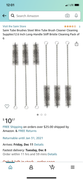
there is the above for like twelve bucks on Amazon. For several of them.
Thoughts?


 Neo
Neo

Me too

I'd love to read the science study that backs up any of their claims ... might be electrifying

 Neo
Neo More like "Shocking",I'd love to read the science study that backs up any of their claims ... might be electrifying

 If the lightning doesn’t kill you, the hernia will.
 And based on the fact that a lighting strike can blow a very large tree in half (extreme current!) how thick do you think that wire would need to be??Bill at BOATS 4 SAIL wrote: ↑Tue Dec 08, 2020 5:17 pm However, the length of a football field in Canada is 110 yards, so there you would need a 110 yard long wire.
.... And some would say that you're tempting a strike by placing a high conductivity (low resistance to earth) point at the top of your mast. And as your wire vaporizes the electrons may attempt a path (to earth) through your aluminium mast which will send splats of molten aluminium everywhere .... or you could just leave your Mac at home Neo
100 yards of #4 wire dragging on the bottom, even more in Canada. That would make a great anchor.

This is why I have decided not to take any lightning protection steps. There is a theory, which may or may not be valid, that grounding the mast or adding a dissipator makes a lightning strike more probable (but maybe less damaging). I, too, have seen nearby lightning strikes, that probably SHOULD have hit the mast, but didn't. Why? Would they have hit if I had a lightning dissipator? Or if I had a mast grounding system? Who knows.charleshagen wrote: ↑Wed Dec 09, 2020 6:55 am In 2015-2016 I sailed the Great Loop (www.greatloop.org) solo. I was going through the Outer Banks in NC when a storm hit suddenly. A lightning bolt hit the water (missing my mast) to my starboard side about 150 yards away.
It was the diameter of a car. All the lightning protection in the world would not have stopped that if it had hit my mast.
Just saying.
I'm in the same place. What little I've learned is that if you don't do it right, you could be making a bigger problem. I'd rather go with stock setup that has proven relatively safe than possibly create a bigger problem.Starscream wrote: ↑Wed Dec 09, 2020 8:43 am So, I don't wanna make things worse by adding an unproven gadget to an X-boat that isn't really deck stepped or keel stepped, but a weird combination of the two with a stainless compression post, and lives in fresh water.

