So I did a rigged a temporary Ronstan 40 shackle block at the bottom of my mast on the mast foot throughbolt's excess threading by putting the shackle and another nylock on it. Been on for a few sails and shows no signs of loosening. The halyard than goes to a a swivel block on the jib track that needs to be replaced by a cheek block, and then through a cam-cleat also on the jib track where the halyard is tensioned. that too eventually needs to go, but I did this mostly because I had most of the hardware on hand from other failed experiments to see whether or not I wanted to permanently lead the halyards back or whether other problems would emerge.
On the good side, the whole system works well and does not impact mast rotation, since the throughbolt is on the rotating side of the mast. I had no issues with that.
But I ran into two immediate problems:
1. Feeding the boltrope into mast slot without jamming. This was solved with an expensive but elegant boltrope feeder ($77) from WM that I'm going to keep on irrespective because it works really well.
2. The damned problem with the halyard catching on the

hound throughbolts. This stupid problem plagues me literally every time I raise the main. 100% of the time on or the other of the halyard lines is caught behind the damned hound bolts.
I'm thinking about replacing the hound throughbolts with this:
http://www.defender.com/product.jsp?pat ... id=1731753
and using the eyebolt holes as fairleads to get the halyard coming down managed to the mast base block. Looks to be a cheap solution that shouldn't affect anything on the hounds in terms of strength.
This doesn't fix the halyard going up, but I can tug on the mainsail from the cabin to clear that. It's the damned down side that I can never get clear.
Anyone see any issues with doing this? I'm still looking for an exact bolt size replacement.


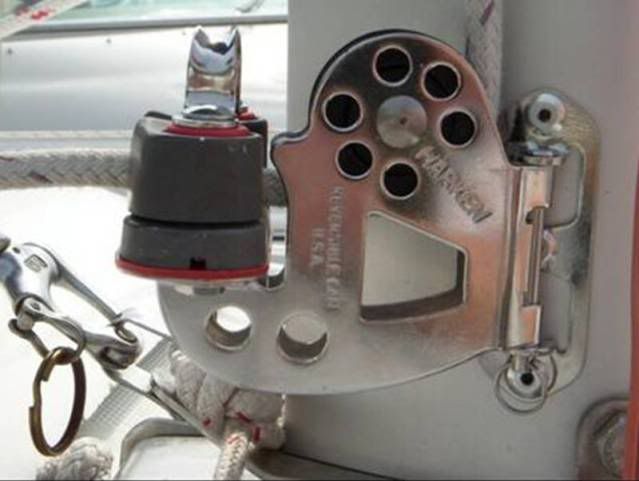
 with a rotating mast, so I can install a lazy jack. The consensus suggests a Harken 140 swiveling block at the bottom of the mast, but this block comes with a self cleating system, which doesn't appear necessary as the halyard will leave the mast at deck level and go around a turning block on the stanchion then back to a clutch near the winch. So, what happens to the cleat built into the block? Maybe there is a swivel block without a cleat but I couldn't find one in the Harken catalogue [UK sp.
  ]
]




 with a
