Hi Land Lady!
There is a “great debate” when it comes to the replacing bunks for rollers for Mac26S/X/M.
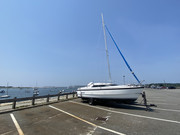
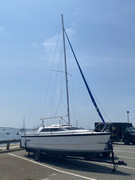
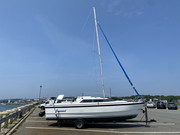
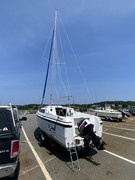
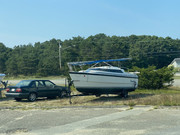
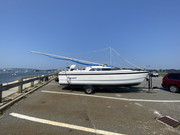
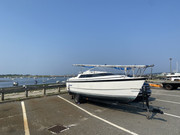
MacGregor designed the original trailers to deliberately use bunks instead of rollers to better distribute the hull loads in transit.
Rollers are basically thin lines of high contact pressure where they contact the hull (cylinder side to flat surface).
While the THICK hulls of power boats may (but definitely not always) be able to handle those high stress concentrations ( at least until a good pothole on the roadway comes along) the THINNER hulls of Mac 26S/X/M will have a more difficult

time handling those stress concentrations.
Mind you, not all damage is obviously catastrophic or blatantly visual. The way fiberglass tends to fail is by progressive inter fiber delaminates within the material thickness. These accumulate over repetitive stress cycles. The higher the stress concentration X the higher the stress loads X the more frequent the loading cycle repetitions = the more likely there is to be damage.
A single 6 foot long by 6 inch wide bunk when properly positioned typically has about 80% contact to hull surface.
So roughly that would be (72” X 5.5”) X 0.8 = 316.8 square inches of functional hull contact area.
Typically there are at least two bunks which provides a total of 633.8 square inches of hull contact area to distribute load transfer between the hull and trailer.
The contact area of a roller cylinder to hull is effectively a line about 3” long without width. But there are some who might say the roller deforms so let’s be generous and say the width of the contact line for a really soft gushy roller is 1”. So the contact area per roller at 100% contact would be 3 square inches.
For rollers to get the equivalent contact area of the 6 foot bunks (@80% contact) it would be (633.8 / 3) = 211.2 rollers.
THAT IS A LOT OF ROLLERS!


(The actuality is that one would need even 3 times as many rollers to match the load distribution of the two 6ft X 5.5in bunks as a roller giving a 1” wide contact width and 100% engagement of all rollers is a bit overly optimistic.) I have seen several instances where soft rollers have degenerated and failed overtime and exposure.
Some of the centering roller sets I’ve had the opportunity to examine tended to have something of a scuffing action to move the heavy power boats associated to center.
A couple mitigations for the potential debris capture of carpet are very short nap indoor/outdoor carpet, low friction plastic surface strips instead of carpet, or Trex boards on top of the support bunks.
While our current bunks are in good shape due to the good efforts of the POs we are choosing to overlay the existing bunks with Trex boards secured with recessed SST screws after removing the existing carpet next year. Currently carpet is in acceptable condition and we power washed them at the DIY Car Wash when we brought the trailer home after launching Over Easy to remove any embedded debris.
We did add a second set of 60in guide poles ahead of the axles this year to complement the two existing ones at the rear that came with the trailer. We have all the guide posts sleeved with vented capped Sch40 PVC pipe. We have a pair of 3/8 tag lines running from the rear posts up to the front winch post to help guide Over Easy centered onto the trailer.
I do like the long side rollers that are available but I have seen them catch and fold their end brackets when retrieving in less than ideal condition while the guide post it was mounted to didn’t appear to sustain any damage.
Of course anything mentioned here is only my perspective and I fully admit there are probably multiple approaches to any given problem.

As always, your boat - your rules!

Enjoy your boat and have fun with it.
The more we use Over Easy the more relaxed and fun it has become.
Best Regards,
Over Easy


 time handling those stress concentrations.