Best upwind speed and VMG

A forum for discussion of how to rig and tune your boat or kicker to achieve the best sailing performance.
fsmith
Just Enlisted
Posts: 21
Joined: Mon Jul 04, 2005 9:40 am

Best upwind speed and VMG

Post by fsmith »

I am sure some of you have done this before, but I came across this by trial and error. Please comment; you will not hurt my feelings and perhaps everybody can learn more.

A hunter 23.5 with Portmouth 94 and PHRF of 224? beats me badly
going tight upwind. Ya'll know how slow the X is :( . and how poorly it points.

Conditions: 10 mile hour winds with some gusts. Centerboard down.
155 Genoa 1st car(forward) and winched down very very tight to completely flatten it. Mainsail Center and trimmed sheets pulled in very tight so all telltales flowing. Now adjust the rudder to maintain about 20 degree heel. In a puff and before it leans to 30, very gently head upwind till it drops to 20 degree heel. In a lull turn away from the wind to maintain the 20 degree heel. Adjust the rudders to maintain optimum heel, instead of letting out the mainsheets or others things to spill wind, or at least till you have tried this first.

The boat felt fastest at this speed and the Hunter could not figure out why he was having a problem catching me. This is because I was pointing higher with good speed. My regret is I did not have my GPS to register speed. Please Try this and give me some feed back!
User avatar
beene
Site Admin
Posts: 2546
Joined: Tue Sep 19, 2006 5:31 pm
Sailboat: MacGregor 26M
Location: Ontario Canada, '07 26M, Merc 75 4s PEGASUS

Post by beene »

Sounds like you were taking advantage of making your own apparent wind angle. More wind speed, more boat speed, better upwind angle. Works evey time.

Another thing I have found, when the average wind speed increases, not just the gusts, keep the head sail tight but back off on the main sheet to keep her at 20 deg. This is as apposed to reefing the main. I have found if you can keep the head sail just on the edge of luffing, you can keep a tight angle upwind while backing off on the main to keep 20 deg and better speeds.

Just from my experiences.

Results may vary.

Consult your Doctor before attempting this is winds over 30kts.

Known side effects may include, but not be limited to, FUN, BIG SMILES, SEVERE LACK OF STRESS, TEARING OF THE EYES FROM THE SHEAR JOY OF IT, IN EXTREME CASES PEOPLE HAVE BEEN REPORTED TO HAVE SHOUTED OUT "BRING IT ON"

8)

G
fsmith
Just Enlisted
Posts: 21
Joined: Mon Jul 04, 2005 9:40 am

I agree and I disagree

Post by fsmith »

We may be thinking of different scenarios or variables but:

I agree that when the headsail starts luffing(we are already max tightened) then we must fall off/turn away from the wind.

I disagree about letting out the main (as of yesterday). In a puff or increasing winds, Try pointing (very gently turning the wheel) higher toward the wind until excessive heeling comes back toward 20 degrees of heel angle. This will allow the boat to maintain speed and point higher. Letting out the mainsheet spills air and loses power, and may choke the slot between the headsail and main. However to keep from broaching it might have to be done. If excessive heel angle continues standard procedures like you described must be done. The first of course is flattening the sails which we have already done. Please give this a try, It may not work for all conditions, but at 10mph winds: it does.
Frank C

Re: Best upwind speed and Velocity Made Good

Post by Frank C »

fsmith wrote: ... 155 Genoa 1st car(forward) and winched down very very tight to completely flatten it.
Translation please?
fsmith wrote: ... A hunter 23.5 with Portmouth 94 and PHRF of 224? beats me badly going tight upwind.

Conditions: 10 mile hour winds with some gusts.
Centerboard down.
155 Genoa 1st car(forward) and winched down very very tight to completely flatten it.
Mainsail Center and trimmed sheets pulled in very tight so all telltales flowing.

Now adjust the rudder to maintain about 20 degree heel. In a puff and before it leans to 30, very gently head upwind till it drops to 20 degree heel. In a lull turn away from the wind to maintain the 20 degree heel.

The boat felt fastest at this speed and the Hunter could not figure out why he was having a problem catching me. This is because I was pointing higher with good speed.
So, sounds like the Hunter easily beat you in the first outing, but you altered strategy? Nice work.

My problem is that winds in our most sheltered area would be 12, gusting 16, and then 18 gusting 25 in the Bay. The rudders are typically overwhelmed and the boat overpowered with the Genoa. I really should just change-down to the jib. Even so, the question of using rudders to manage heel .... when it's a**holes & elbows, dainty don't work.

Last week I found the reefed Genny & reefed main generally nicely balanced, but varying combinations of current and gusts had the boat alternately showing lee helm, then weather-helm. This was during short-tacking across a channel, maybe 200 yards wide. Still, your notes are valuable and appreciated.
waternwaves
Admiral
Posts: 1499
Joined: Wed Oct 13, 2004 8:18 pm
Location: X less in North Puget Sound -have to sail other boats for a while

Post by waternwaves »

Frank.

Hmmm, I cant say we ever have winds as consistent as yours.....in the 20+ range.... past 20 it seems to be very gusty....and uneven

But Most up here are still flying the full genny well past the point of going to the first reef of the main to keep that 20 degrees.

Maybe it is just the extreme weight of my boat... but that main seems to provide more heel than the jib when the tunnel is tight.
User avatar
beene
Site Admin
Posts: 2546
Joined: Tue Sep 19, 2006 5:31 pm
Sailboat: MacGregor 26M
Location: Ontario Canada, '07 26M, Merc 75 4s PEGASUS

Post by beene »

I disagree about letting out the main (as of yesterday). In a puff or increasing winds, Try pointing (very gently turning the wheel) higher toward the wind until excessive heeling comes back toward 20 degrees of heel angle
That is why I was trying to be clear when I said..
Another thing I have found, when the average wind speed increases, not just the gusts,
... soooo, just to be clearer, what you are doing works great, til the average wind speed increases to a point where you are heeling beyond 20 all or most of the time. At that point, I have found that you can keep the headsail just under luffing, pointing as high as you can, but the heel is too great, letting out the mainsheet is directly proportional to the amount of heel you have. Very touchy. Just a bit of line equals several degrees of heel while keeping the headsail as high as she'll point.

But then again, that is just from my experience.

Hope that is more clear.

Much easier to show someone than it is to spell it out, I find anyway.

Cheers

G
User avatar
Catigale
Site Admin
Posts: 10421
Joined: Fri Jun 11, 2004 5:59 pm
Sailboat: MacGregor 26X
Location: Admiral .............Catigale 2002X.......Lots of Harpoon Hobie 16 Skiffs....Island 17
Contact:

Post by Catigale »

The jib will point much better than the genny in higher winds - better shape, especially compared to a furled genny, and can be sheeted in tighter on the front jib tracks..
User avatar
beene
Site Admin
Posts: 2546
Joined: Tue Sep 19, 2006 5:31 pm
Sailboat: MacGregor 26M
Location: Ontario Canada, '07 26M, Merc 75 4s PEGASUS

Post by beene »

When a boat is reaching or beating, the apparent wind is of greater velocity than the true wind. You are, in effect, "making your own wind." In iceboating this is an important part of the resulting high speeds. Some iceboats, for instance, can reach speeds five to six times the speed of the wind and can attain speeds of 120 knots in 24 knots of wind. The faster the boat goes, the higher the wind velocity it creates. Only because of the lack of friction can these high speeds be attained. A normal sailboat is limited in speed by hull resistance, skin friction, and wave-making drag, so it cannot take full advantage of the increased apparent-wind velocity. A planing sailboat is more apt to get up on a high-speed plane while on a reach rather than a run just because of this apparent-wind increase. Even so, the faster a boat is to windward, the more close-winded (able to head close to the wind) it must be.

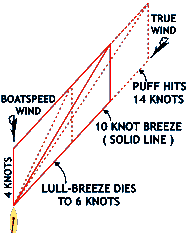
Now say boat is keeping the true-wind direction at 45 degrees off the bow.
Image

Notice that the wind speed was initially 10 knots and the boat speed four knots. The dotted extension of the true wind line indicates a four-knot increase or puff. So we see a basic axiom: "In a puff, the apparent wind comes aft." To be correct, this necessitates a constant speed on the boat's part. Generally, however, by the time the boat picks up speed the puff has passed, so the axiom holds true.


We already know that we point higher in order to reduce heeling when hit by an overpowering gust. This axiom shows another reason to do the same thing. As the gust hits, the apparent wind goes aft causing more heeling and less drive and changing the angle of incidence—the angle the apparent wind makes with the sails—so that the sails are now improperly trimmed unless you head up or ease the sheets or traveler. This change in apparent-wind direction is important to remember even on light days. When you have a three-knot breeze, the wind velocity in a puff is apt to be more than double the regular breeze. When it is blowing 15 knots, gusts may get to only 20 or 22 knots, or about a third higher. Thus, the change in apparent-wind direction aft is often greater on light days than on heavy ones.

The dot-dash lines in the diagram show the resulting change in apparent wind when the wind dies suddenly. With the boat speed remaining constant and the wind velocity lowering to six knots, the apparent wind goes forward. This is one of the reasons that small catamarans rarely carry spinnakers. If they do carry a spinnaker, it is a flat, asymmetrical sail much like a reaching genoa. The hulls have very little resistance to the water, and the cats sail downwind almost as fast as the wind, making it very difficult to keep a spinnaker drawing. If the wind dies for a moment, the spinnaker collapses and it is very difficult to get it filled until the boat slows down. Therefore, small cats, much like iceboats, tack downwind by jibing. By sailing from reach to reach, they pick up greater speed and make up the extra distance sailed.

G
User avatar
baldbaby2000
Admiral
Posts: 1382
Joined: Sun Mar 28, 2004 8:41 am
Location: Rapid City, SD, 2005 26M, 40hp Tohatsu
Contact:

Post by baldbaby2000 »

What Beene has said should be expanded to include what to do when the wind speed drops.

As he said, when the true wind speed increases but direction stays the same, the boat will see a "lift," the apparent wind moves aft and the boat will be able to point higher as it comes up to speed. If the wind speed drops you get the opposite effect and you will see a "header," the apparent wind moves forward because of your boat speed. In my opinion instead of heading down to fill the sails, you should hold your course and when the boat speed reduces enough the sails will fill (see velocity header). If you click on the link he says in chop you may want to head down to maintain drive.

Having said all that, experiment like you're doing and let us know the results. Comparing yourself to a known boat is a good way to get a feel for the effect of your adjustments.

Daniel
User avatar
delevi
Admiral
Posts: 2184
Joined: Fri May 06, 2005 1:03 am
Location: San Francisco Catalina 380, former 26M owner
Contact:

Post by delevi »

Good stuff. Fsmith, congrats on your strategy to beat the Hunter. I'm surprised, however, that it beat you the first time. I mentioned in a different thread that I outsailed a larger Hunter (appox 35') in SF Bay. Perhaps the crew was on a wine break :D It certainly wasn't a race, but to paraphrase Roger: "Every time two boats sail alongside one another, you have yourself a race, and sailboat racing is fun." :P
As the gust hits, the apparent wind goes aft causing more heeling and less drive and changing the angle of incidence
Ok, now I'm confused. My understanding is that apparent wind is always forward of true wind. Am I missing something?

As for the pinching technique, I too found this quite effective in managing heel. Just to expand a bit further... I found that when pointing high, but not pinching and getting hit with a gust to the point of weather helm, I found that it's best not to fight it. A quick quarter turn of the wheel to leeward and back to center. Oftentimes this keeps you on track and prevents a rudder stall. If not effective, keep the helm centered and allow the boat to head up a bit, then repeat the quick quarter turn and back to center. She will either come back to its original course or just sail higher on a borderline pinch. At that point, trim in the sails and keep going on the new groove. What I love about sailing is I learn something new almost every time out. Turns out it's the small subtleties that can really help make the experience more enjoyable and the sailing more efficient.

Leon
User avatar
baldbaby2000
Admiral
Posts: 1382
Joined: Sun Mar 28, 2004 8:41 am
Location: Rapid City, SD, 2005 26M, 40hp Tohatsu
Contact:

Post by baldbaby2000 »

Quote:
As the gust hits, the apparent wind goes aft causing more heeling and less drive and changing the angle of incidence

Ok, now I'm confused. My understanding is that apparent wind is always forward of true wind. Am I missing something?
Leon,

Yes, the apparent wind is forward of the true wind but when the gust hits it moves further aft from where it was but still stays forward of the true wind (assuming you're moving forward). This is why you always get a lift during a gust when the true wind direction doesn't change. Then if the wind dies you get a "velocity header." In this case the apparent wind moves forward and even though your sails may luff you should consider holding your course because as the boat slows the apparent wind will move aft again and fill the sails.

You can extend the concept to a downwind leg. If you're broad reaching towards a downwind mark, and the wind speed slows, head more downwind so that the boat speed you built up counts more towards the VMG to the downwind mark. Then when the wind comes up again head up a little. At least this is what we did in the scow racing I use to do but they were much faster boats. Maybe on a Mac the downwind methods don't matter as much; it may be as fast to go dead downwind as it is to reach.

Daniel
User avatar
delevi
Admiral
Posts: 2184
Joined: Fri May 06, 2005 1:03 am
Location: San Francisco Catalina 380, former 26M owner
Contact:

Post by delevi »

Thanks for that Daniel. Makes sense.
Maybe on a Mac the downwind methods don't matter as much; it may be as fast to go dead downwind as it is to reach.
Not in my expeirence. Broad reaching is much faster than DDW.... w/ regular sail config. Not talking about usin the sping since I used mine so few times.

Any idea where I can read about the 101 of racing? I never raced and I know virtually nothing about markers, rules PRHF, etc. Suppose I can Google it, but if anyone knows of some good info off hand, I'd appreciate it.

Cheers,
Leon
User avatar
Scott
Admiral
Posts: 1654
Joined: Tue May 18, 2004 12:46 pm
Sailboat: Venture 25
Location: 1978 Catalina 22 with all the Racing Goodies!! 4 horse fire breathing monster on the transom

Post by Scott »

Maybe on a Mac the downwind methods don't matter as much; it may be as fast to go dead downwind as it is to reach.
Not so. Ever notice how race boats never go DDW. It is ALWAYS faster to reach than to run. Spinnaker included!

Take note

Image
eric3a

Post by eric3a »

..
Last edited by eric3a on Tue Mar 11, 2008 7:01 pm, edited 1 time in total.
Frank C

Post by Frank C »

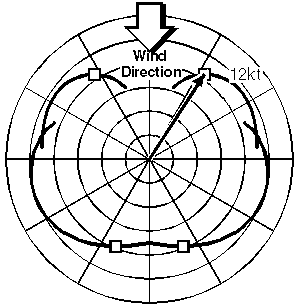
eric3a wrote:Whoa! Is that the Mac's polar curve?
Doubtful ... extremely doubtful.

We're still waiting on you for the Mac's polars.
Post Reply