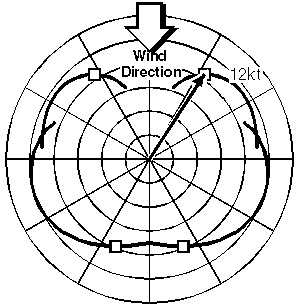
When a boat is reaching or beating, the apparent wind is of greater velocity than the true wind. You are, in effect, "making your own wind." In iceboating this is an important part of the resulting high speeds. Some iceboats, for instance, can reach speeds five to six times the speed of the wind and can attain speeds of 120 knots in 24 knots of wind. The faster the boat goes, the higher the wind velocity it creates. Only because of the lack of friction can these high speeds be attained. A normal sailboat is limited in speed by hull resistance, skin friction, and wave-making drag, so it cannot take full advantage of the increased apparent-wind velocity. A planing sailboat is more apt to get up on a high-speed plane while on a reach rather than a run just because of this apparent-wind increase. Even so, the faster a boat is to windward, the more close-winded (able to head close to the wind) it must be.
Now say boat is keeping the true-wind direction at 45 degrees off the bow.
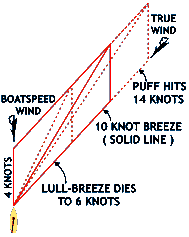
Notice that the wind speed was initially 10 knots and the boat speed four knots. The dotted extension of the true wind line indicates a four-knot increase or puff. So we see a basic axiom: "In a puff, the apparent wind comes aft." To be correct, this necessitates a constant speed on the boat's part. Generally, however, by the time the boat picks up speed the puff has passed, so the axiom holds true.
We already know that we point higher in order to reduce heeling when hit by an overpowering gust. This axiom shows another reason to do the same thing. As the gust hits, the apparent wind goes aft causing more heeling and less drive and changing the angle of incidence—the angle the apparent wind makes with the sails—so that the sails are now improperly trimmed unless you head up or ease the sheets or traveler. This change in apparent-wind direction is important to remember even on light days. When you have a three-knot breeze, the wind velocity in a puff is apt to be more than double the regular breeze. When it is blowing 15 knots, gusts may get to only 20 or 22 knots, or about a third higher. Thus, the change in apparent-wind direction aft is often greater on light days than on heavy ones.
The dot-dash lines in the diagram show the resulting change in apparent wind when the wind dies suddenly. With the boat speed remaining constant and the wind velocity lowering to six knots, the apparent wind goes forward. This is one of the reasons that small catamarans rarely carry spinnakers. If they do carry a spinnaker, it is a flat, asymmetrical sail much like a reaching genoa. The hulls have very little resistance to the water, and the cats sail downwind almost as fast as the wind, making it very difficult to keep a spinnaker drawing. If the wind dies for a moment, the spinnaker collapses and it is very difficult to get it filled until the boat slows down. Therefore, small cats, much like iceboats, tack downwind by jibing. By sailing from reach to reach, they pick up greater speed and make up the extra distance sailed.
G


 . and how poorly it points.


 It certainly wasn't a race, but to paraphrase Roger: "Every time two boats sail alongside one another, you have yourself a race, and sailboat racing is fun."